What is SEO? Meaning, Pillars and Simple Guide of 2026
Published: 5 Aug 2026
Have you ever wondered why some websites always show up on the first page of Google while others stay hidden on page five? The answer to this question is SEO. If you are searching for what is SEO, you have landed in the right place. Consider this your complete introduction to SEO and a simple SEO overview before diving deeper.
In this guide, you will learn the SEO meaning, how it works, its main pillars, the factors that affect rankings, who can influence it, and how a beginner can start learning it step by step.
What is SEO?
The full form of SEO is Search Engine Optimization. In simple words, search engine optimization is the process of improving a website so that search engines like Google can understand it, trust it, and show it to the right people.
This is the simplest way to explain what is search engine optimization in simple words: when someone types a question into Google, the search engine looks through millions of pages and picks the ones that answer that question best. SEO is the practice that helps a website become one of those chosen pages.
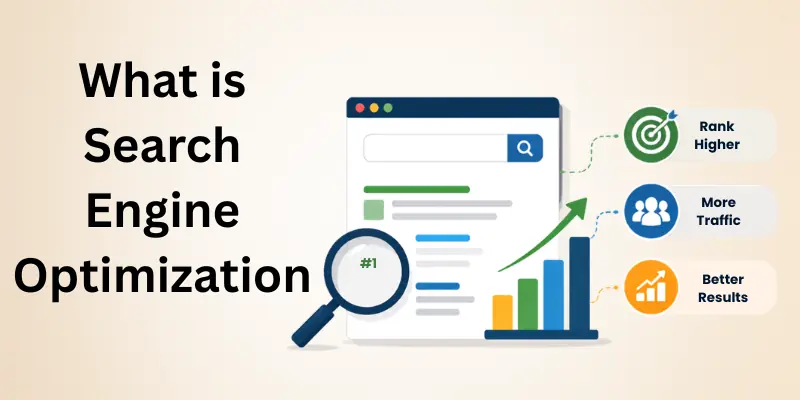
To explain search engine optimization in even simpler terms, think of it as making a shop easy to find, easy to enter, and easy to trust. A well optimized website gets more visitors without paying for ads.
Why SEO Matters (SEO Importance)
SEO importance becomes easier to understand once you see why businesses invest so much time in it. Search engine optimization is not just a technical task. It directly affects how many people find a business online.
- Brings free and steady traffic from search engines
- Builds trust with users who see the website on top results
- Helps small businesses compete with bigger brands
- Improves user experience through faster and cleaner websites
- Supports long-term growth instead of short-term ad spending
- Increases the chances of getting clicks and conversions
- Helps content reach the people who are actually looking for it
- Keeps a business visible even while it is not actively advertising
Once you understand why SEO matters, the next natural step is to look at the main parts that hold this practice together.
Pillars of SEO
SEO is not one single activity. It stands on a few core pillars, and each one plays its own role in helping a website rank well.
- Technical SEO: Makes sure the website loads fast, works well on mobile, and is easy for search engines to crawl and index.
- On Page SEO: Focuses on the content, titles, headings, and keywords placed directly on a webpage.
- Off Page SEO: Builds the website’s reputation through backlinks, mentions, and outside signals of trust.
- Content: Provides useful, clear, and relevant information that answers what the reader is actually searching for.
- User Experience: Ensures visitors find the website easy to use, read, and navigate once they arrive.
- Local SEO: Helps businesses appear in searches related to their city or nearby area.
Now that the pillars are clear, it becomes easier to understand how all these pieces work together in practice.
How Does SEO Work?
SEO works by helping search engines understand a webpage and match it with the right search query. Search engines use programs called crawlers to scan websites, collect information, and store it in a large index.
When a person searches for something, the search engine checks its index and ranks pages based on relevance, quality, and trust. Pages that are well structured, load quickly, and answer the search query clearly tend to rank higher.
It guides a website to speak the same language as search engines while still staying useful and readable for real visitors. In short, this shows what is SEO and how it works together in practice.
What Factors Affect SEO Rankings?
Search engines look at many signals before deciding which page deserves a higher position. Some factors carry more weight than others, but together they shape the final ranking.
- Quality and relevance of content
- Website loading speed
- Mobile friendliness
- Secure connection through HTTPS
- Number and quality of backlinks
- Proper use of keywords in titles and headings
- Clear website structure and easy navigation
- Overall user experience on the page
These factors work together rather than separately, which is why strong SEO always looks at the full picture instead of just one element.
Who Can Affect SEO?
SEO results are rarely shaped by just one person. Different roles contribute to how a website performs on search engines.
- Website owners, who decide on structure, design, and overall strategy
- Content writers, who create the material that answers search queries
- Developers, who handle site speed, coding, and technical setup
- SEO specialists, who research keywords and guide optimization efforts
- Marketing teams, who align SEO with wider business goals
- Users themselves, whose clicks, time on page, and engagement send signals back to search engines
Once these roles work in the same direction, SEO efforts become far more effective.
How to Learn SEO
Learning the SEO basics does not require a technical background. This SEO guide for beginners works well even for someone with zero prior experience, since a clear starting point makes the whole process much simpler.
- Understand the basics: Learn what SEO means and why search engines use it to rank pages.
- Study real websites: Look at top-ranking pages and notice their structure and content style.
- Learn keyword research: Practice finding the words people actually type into search engines.
- Focus on content quality: Write content that answers a clear question in a simple way.
- Learn on page basics: Understand titles, headings, and internal links.
- Explore technical basics: Learn how site speed and mobile design affect rankings.
- Practice regularly: Apply small SEO changes on a sample website or blog.
- Follow updates: Search engines change their rules often, so staying updated matters.
- Get feedback: Share your work and learn from suggestions to improve faster.
This SEO guide for beginners gives a starting structure, and covering these SEO basics for beginners early makes the learning curve much smoother, but real understanding grows only with consistent practice.
Now that you know how to learn SEO, the next natural question is how this skill can turn into real income.
How to Earn from SEO
Earning from SEO becomes easier when you build a few solid skills and apply them in real projects. Many beginners start small and grow their income as their results improve.
- Learn the fundamentals: Get comfortable with keywords, content, and basic technical concepts.
- Practice on a real site: Start a small blog or website to apply what you learn.
- Build sample results: Track improvements you make so you have proof of your skills.
- Offer services on freelance platforms: Create profiles on sites like Fiverr or Upwork to find early clients.
- Start with small projects: Take simple audits or content tasks to build experience and reviews.
- Specialize over time: Focus on one area, such as on page SEO or local SEO, to stand out.
- Collect client feedback: Use reviews and results to improve your offers and pricing.
- Increase your rates gradually: As your portfolio grows stronger, charge more for your expertise.
With steady practice, SEO can turn into a reliable income source, whether through freelancing, agency work, or an in-house role.
Pros and Cons of SEO
Search engine optimization brings strong benefits, but it also comes with a few real challenges worth knowing before diving in.
- Brings long term and mostly free traffic
- Builds credibility and trust with users
- Works well alongside other marketing efforts
- Improves overall website quality and speed
- Offers strong career and freelancing opportunities
- Helps businesses of any size compete online
- Results take time and do not appear overnight
- Search engine rules change frequently
- Requires ongoing effort and monitoring
- High competition in popular niches
- Some technical parts can feel complex at first
- Mistakes can sometimes lower rankings instead of improving them
Knowing both sides helps set realistic expectations before starting any SEO effort.
Future of SEO
Search engine optimization keeps evolving as search engines get smarter and user behaviour keeps shifting. Voice search, AI powered results, and mobile first browsing are already shaping how SEO looks today.
- Growth in voice and conversational search
- Rising importance of AI generated search results
- Greater focus on mobile first experiences
- Increased demand for high quality and original content
- Stronger emphasis on user experience signals
- More opportunities for SEO focused careers
- Continued shift toward local and personalized search
- Long term value for websites that stay consistent
Even with these changes, the core idea stays the same. Search engines still want to show real value to real people, and that keeps SEO relevant for the years ahead.
Conclusion
So, now the picture around what is SEO should feel much clearer. This guide covered its meaning, pillars, working process, ranking factors, and the people who influence it, along with a simple path for beginners to start learning.
SEO remains one of the most valuable skills for anyone building a presence online, whether for a personal blog or a growing business. Small, consistent steps in learning search engine optimization can lead to strong and lasting results over time.
Keep exploring, keep practicing, and the results of good SEO will show up in time. Before wrapping up completely, here are a few common questions beginners often ask about SEO.
FAQs
Let’s check the unique FAQs with basic answers about SEO.
SEO means Search Engine Optimization. It is the process of improving a website so search engines can find, understand, and rank it higher. The main goal is to bring more visitors through organic search results. It does not involve paying for ads directly.
SEO is used to help websites appear higher in search engine results. It supports business growth, brand visibility, and organic traffic. Many businesses use it instead of or alongside paid advertising. It also improves the overall quality of a website.
SEO is not hard to learn, but it does require regular practice. The basics like keywords and content quality can be understood quickly.
Technical parts may take a bit more time and patience. Consistency matters more than speed while learning.
SEO usually takes a few months to show noticeable results. The exact time depends on competition, content quality, and consistency. Unlike ads, SEO builds results gradually rather than instantly. Patience plays a big role in seeing success.
On page SEO focuses on elements within the website, like content and headings. Off page SEO focuses on outside signals, mainly backlinks and mentions.
Both work together to build a website’s overall ranking strength. Neither one works well alone for long term results.
A website can technically appear in search results without SEO, but its ranking will likely stay low. Without optimization, search engines struggle to understand the content properly.
This usually leads to little to no organic traffic. SEO simply improves the chances of better visibility.
SEO mainly focuses on Google since it holds the largest search market share. However, the same principles apply to other search engines too.
Bing and other platforms also value quality content and good site structure. Learning core SEO skills works across most search engines.
SEO remains a strong skill to learn in 2026 because businesses continue moving online. Demand for SEO knowledge is rising across freelancing and full time roles.
It also pairs well with content writing and digital marketing skills. Learning it now can open several career paths later.






- Be Respectful
- Stay Relevant
- Stay Positive
- True Feedback
- Encourage Discussion
- Avoid Spamming
- No Fake News
- Don't Copy-Paste
- No Personal Attacks
- Be Respectful
- Stay Relevant
- Stay Positive
- True Feedback
- Encourage Discussion
- Avoid Spamming
- No Fake News
- Don't Copy-Paste
- No Personal Attacks
