SEO vs SEM: Simple Comparison Guide
Published: 13 Aug 2026
Here’s something that surprises most beginners: two websites can target the exact same keyword, sit right next to each other on Google, and still be playing a completely different game. That’s the real story behind SEO vs SEM, and once you see it, choosing where to put your time and money stops feeling like a guessing game. Some people pour months into content and wonder why nothing moves.
Others launch ads on day one and watch their budget vanish without a single lasting result.I have watched this mix-up trip up beginners again and again, and it’s rarely because they lack effort. It’s because nobody explained the difference in a way that actually clicks. That changes today, so let’s clear it up once and for all.
Overview of Both
SEO stands for search engine optimization. It focuses on improving your website’s ranking on search engines through organic, unpaid methods. Writers and marketers work on keywords, content quality, site structure, and backlinks to help a page rank higher naturally. It suits people who want steady, long-term traffic without paying for every click.
Examples: blog content, on-page optimization, and backlink building.
What is SEM?
SEM stands for search engine marketing. It focuses on gaining visibility through paid advertising on search engines. Marketers bid on keywords, write ad copy, and set budgets to place their website at the top of search results instantly. It suits people who want quick, measurable traffic and don’t mind paying for it.
Examples: Google Ads, PPC campaigns, and sponsored listings.
Difference Between SEO and SEM
Digital marketing offers many ways to bring traffic to a website, but SEO and SEM remain the two most popular paths. Both aim to boost visibility, but they work in very different ways.
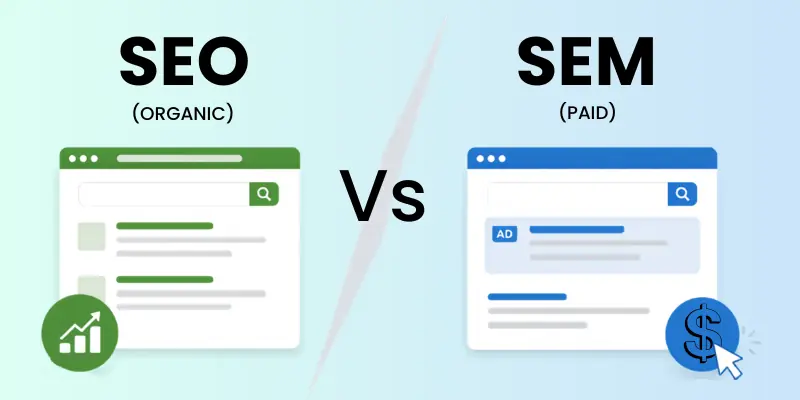
This difference between SEO and SEM becomes clear once you compare their purpose, cost, speed, and long-term value.
Let’s break it down point by point.
1. Purpose
Both methods want to bring visitors to your website, but they achieve this goal differently. One builds visibility slowly through content, while the other buys visibility instantly through ads.
SEO
- Builds organic visibility over time.
- Improves website quality and relevance.
- Supports long-term brand growth.
- Helps your site earn trust with search engines.
SEM
- Buys instant visibility through ads.
- Places your website at the top for chosen keywords.
- Supports quick promotions and campaigns.
- Helps you reach customers right away.
2. Cost
Money plays a big role in choosing between these two paths. One needs time investment, while the other needs a direct budget for ads.
SEO
- Doesn’t require payment for clicks.
- Costs come from content creation or hiring an expert.
- Investment builds value that lasts.
- Results don’t disappear once spending stops.
SEM
- Requires payment for every click on your ad.
- Budget controls how much visibility you get.
- Traffic stops the moment you stop paying.
- Costs can rise in competitive industries.
3. Speed of Results
Some strategies show results quickly, while others take patience. This is one of the biggest factors people consider when comparing SEO versus SEM.
SEO
- Takes weeks or months to show ranking improvements.
- Growth builds gradually as trust increases.
- Results feel slow but steady.
- Best suited for long-term goals.
SEM
- Shows results within hours of launching a campaign.
- Traffic starts as soon as the ad goes live.
- Growth feels immediate and measurable.
- Best suited for urgent promotions.
4. Traffic Type
The kind of visitor each method attracts can differ too. Organic clicks feel different from paid clicks, and both bring their own value.
SEO
- Attracts organic, unpaid clicks.
- Visitors often trust organic results more.
- Traffic grows naturally with better content.
- Clicks don’t cost anything directly.
SEM
- Attracts visitors through paid ad placements.
- Ads appear above organic results.
- Traffic depends on active ad spend.
- Clicks are marked clearly as sponsored.
5. Longevity
How long results last is another major difference. This point often decides which strategy fits a business better.
SEO
- Results can last for months or years.
- Rankings stay even without daily spending.
- Content keeps working after it’s published.
- Growth compounds over time.
SEM
- Results last only while the campaign runs.
- Visibility disappears once the budget ends.
- Traffic needs constant funding to continue.
- Growth doesn’t compound on its own.
6. Control Over Ranking
Control over where your website appears also varies between the two approaches.
SEO
- Ranking depends on search engine algorithms.
- Results can shift with algorithm updates.
- Full control isn’t guaranteed.
- Consistency requires ongoing effort.
SEM
- Ranking position depends on your bid and budget.
- You control exactly which keywords you target.
- Placement feels more predictable.
- Adjustments can happen instantly.
7. Skills Required
Each strategy demands a different skill set from the person managing it.
SEO
- Needs keyword research and content writing skills.
- Understanding of technical website factors helps.
- Patience and consistency matter a lot.
- Analytical thinking improves long-term results.
SEM
- Needs skills in ad copywriting and bidding strategy.
- Understanding of budget management is essential.
- Quick decision-making helps optimize campaigns.
- Data analysis guides daily adjustments.
8. Tools Used
Different tools support each strategy, helping marketers plan and track their progress.
SEO
- Uses tools like Google Search Console and keyword planners.
- Backlink trackers help measure authority.
- Content and SEO audit tools guide improvements.
- Analytics tools track organic growth.
SEM
- Uses platforms like Google Ads and Microsoft Ads.
- Bid management tools help control spending.
- A/B testing tools improve ad performance.
- Conversion tracking measures campaign success.
9. Best For
Choosing between the two also depends on your business goals and timeline.
SEO
- Fits businesses planning for long-term growth.
- Works well for building brand authority.
- Suits those with limited advertising budgets.
- Ideal for content-driven websites.
SEM
- Fits businesses needing fast results.
- Works well for time-sensitive offers or launches.
- Suits those with a dedicated ad budget.
- Ideal for testing new products quickly.
10. Combining Strategy
Many marketers don’t treat this as an SEO or SEM choice at all. Instead, they use both together for stronger results.
SEO
- Builds a strong foundation for organic growth.
- Supports SEM by improving landing page quality.
- Reduces long-term dependency on ad spend.
- Keeps traffic flowing even during low-budget periods.
SEM
- Fills the gap while SEO results are still growing.
- Tests keywords that SEO can target later.
- Boosts visibility during important campaigns.
- Works alongside SEO for faster overall growth.
11. Trust Factor
The way visitors perceive your website also depends on where they find you. Trust builds differently depending on which path brings the click.
SEO
- Organic results often feel more credible to visitors.
- People trust rankings earned through relevance and quality.
- Trust builds slowly as your site proves its value.
- Visitors see your site as a genuine answer to their search.
SEM
- Ads carry a “sponsored” label that some visitors notice.
- Trust depends on strong ad copy and landing pages.
- Visitors may skip ads if they favor organic listings.
- Trust builds instantly with a well-crafted, relevant offer.
12. Scalability
Growing your traffic isn’t always as simple as flipping a switch. Each strategy scales in its own way.
SEO
- Scaling requires more content, links, and time.
- Growth speeds up once your site earns authority.
- Expansion into new topics takes ongoing effort.
- Results snowball rather than jump overnight.
SEM
- Scaling happens by increasing your budget.
- Growth speeds up the moment you raise your spend.
- Expansion into new keywords takes minutes, not months.
- Results grow in direct proportion to your investment.
13. Measurement and Analytics
Tracking success looks different for each approach, and this shapes how marketers judge performance.
SEO
- Success is measured through rankings, organic traffic, and dwell time.
- Progress can take weeks to reflect in the data.
- Metrics show gradual, cumulative improvement.
- Attribution can feel harder to pin down precisely.
SEM
- Success is measured through clicks, conversions, and cost per action.
- Progress shows up in real time on the dashboard.
- Metrics reveal exactly what’s working and what isn’t.
- Attribution stays clear since every click is tracked.
14. Competition Level
How crowded the space feels also changes depending on which path you choose.
SEO
- Competing for top rankings can take months against established sites.
- Smaller sites can still win with niche, high-quality content.
- Competition shifts slowly as sites gain or lose authority.
- Outranking a rival doesn’t cost you extra money directly.
SEM
- Competing for ad space can raise your cost per click instantly.
- Bigger budgets often win the top ad positions.
- Competition shifts the moment rivals adjust their bids.
- Outbidding a rival costs you more with every click.
15. Risk Level
Every strategy carries some risk, and knowing this helps you plan with fewer surprises.
SEO
- Algorithm updates can shift rankings without warning.
- Recovery from a drop can take time and effort.
- Risk stays low since there’s no daily spending involved.
- A slow start doesn’t drain your budget.
SEM
- Poor targeting can burn through budget with no return.
- Recovery is as fast as pausing or adjusting the campaign.
- Risk feels higher since money is spent continuously.
- A slow start can get expensive fast.
Now you can see the full picture of how these two strategies compare. Ready for a quick summary that puts everything side by side?
Comparison Table: SEO vs SEM
Here’s a simple table to make the comparison between SEO and SEM even easier.
| Key Aspect | SEO | SEM |
|---|---|---|
| Goal | Build organic visibility | Buy instant visibility |
| Cost | No direct click cost | Pay per click |
| Speed | Slow, builds over time | Fast, works immediately |
| Traffic | Organic, unpaid | Paid, ad-driven |
| Longevity | Lasts long-term | Lasts while campaign runs |
| Control | Depends on algorithms | Depends on your bid |
| Skills Needed | Content and research skills | Ad copy and budget skills |
| Best Use | Long-term brand growth | Quick promotions and launches |
Conclusion
Here’s the wonderful part about understanding SEO vs SEM: you’re no longer choosing a side, you’re unlocking two engines that can grow your website at once. SEO plants seeds that keep growing long after you stop watering them. SEM hands you a shortcut when you need eyes on your site right now. Neither one is the villain here. The real risk only shows up when you lean on just one and ignore the other.
Set clear goals, track your numbers, and let SEO and SEM support each other instead of competing for your attention. That’s how smart brands quietly pull ahead while everyone else is still picking a side. I appreciate your time, and I’m genuinely excited to see where this takes your online presence.
FAQs
Still curious about a few things? Here are the questions people ask most often about search engine optimization vs search engine marketing.
SEO focuses on earning organic traffic through content and optimization, while SEM focuses on buying traffic through paid ads. SEO takes longer but keeps working without ongoing payment.
SEM works fast but stops once you stop paying. Both aim to increase website visibility in different ways.
Search engine optimization improves your site’s natural ranking through content and technical fixes. Search engine marketing uses paid campaigns to place your site at the top instantly.
The search engine marketing vs search engine optimization debate often comes down to budget and timeline. Businesses with patience lean toward SEO, while those needing fast results choose SEM.
Neither option is better on its own since they serve different goals. SEO works best for steady, long-term growth without ongoing ad spend.
SEM works best when you need immediate traffic for a launch or promotion. Many businesses get the best results by using both together.
Yes, SEM shows results almost immediately after a campaign goes live. SEO takes weeks or months to build ranking and trust with search engines.
If you need traffic urgently, SEM delivers quicker outcomes. SEO remains the better choice for lasting, long-term visibility.
Yes, combining both strategies often brings the strongest results. SEM can bring quick traffic while your SEO efforts slowly build organic ranking.
SEO also improves your landing pages, which makes your SEM campaigns perform better. Many successful websites rely on this combined approach.
SEM usually costs more in the short term since you pay for every click. SEO costs come mainly from content creation, tools, or hiring an expert.
Over time, SEO can become more cost-effective as it keeps generating traffic without extra payment. SEM spending stops delivering results the moment you pause it.
No, SEO traffic continues even if you never run paid ads. Once your content ranks well, it keeps attracting visitors naturally.
SEM simply adds an extra, faster traffic source alongside SEO. The two strategies work independently but perform even better together.
SEO is generally better for long-term results since rankings can last for months or years. SEM only delivers traffic while the campaign is active and funded.
For lasting brand growth and consistent visitors, SEO remains the stronger long-term choice. SEM works best as a short-term boost alongside it.


- Be Respectful
- Stay Relevant
- Stay Positive
- True Feedback
- Encourage Discussion
- Avoid Spamming
- No Fake News
- Don't Copy-Paste
- No Personal Attacks
- Be Respectful
- Stay Relevant
- Stay Positive
- True Feedback
- Encourage Discussion
- Avoid Spamming
- No Fake News
- Don't Copy-Paste
- No Personal Attacks
