Advantages and Disadvantages of SEO: Search Engine Optimization
Published: 8 Aug 2026
If you run a website or a business online, you have probably heard people talk about SEO. Search engine optimization can drive visitors, build your brand, and help people find you on Google without paying for every click. But like every other marketing method, it also comes with its own set of challenges.
The advantages and disadvantages of SEO help you set realistic expectations and decide if this strategy fits your goals. You will learn the key benefits SEO offers, the difficulties it brings, and how to make it work in your favor. Whether you are a beginner or someone already working on a website, this guide gives you a clear and honest look at the pros and cons of SEO.
SEO Advantages
SEO is a skill that shapes how people discover a business online. It is not only about ranking on Google, but it is also about building a website that search engines trust and users enjoy visiting.
Once you understand the advantages of SEO, you will see why so many businesses invest time and money into building a strong search presence.
- Organic Traffic
- Cost-Effective Marketing
- Long-Term Results
- Trust and Credibility
- User Experience
- Return on Investment
- Competitive Advantage
- Support for Marketing Channels
The following points explain why SEO remains one of the most valuable digital marketing tools available today.
1. Organic Traffic
SEO helps a website appear in search results for the terms people already search for. This brings visitors who are actively looking for what you offer. One of the biggest SEO benefits is a steady stream of organic traffic that does not stop the moment you pause your budget.
Key Advantages:
- Steady flow of interested visitors
- Traffic that does not depend on daily ad spend
- Wider reach over time
2. Cost-Effective Marketing
Unlike paid ads, SEO does not charge you for every click. Once your content ranks well, it keeps attracting visitors without extra cost. This is one of the clearest benefits of SEO for small businesses working with limited budgets.
Key Advantages:
- Lower long-term marketing cost
- No charge per visitor
- Better value for small budgets
3. Long-Term Results
Paid campaigns stop working the moment you stop paying. SEO results, on the other hand, tend to stay active for a longer period. Content that ranks well can continue bringing traffic for months or even years.
Key Advantages:
- Results that last beyond the campaign
- Reduced dependence on constant spending
- Stronger long-term online presence
4. Trust and Credibility
Websites that rank high on search engines often appear more trustworthy to users. People tend to believe that top results are more reliable and relevant. Good SEO practices also improve site structure, which adds to this sense of credibility.
Key Advantages:
- Higher perceived trust from users
- Stronger brand reputation
- Better first impression for new visitors
5. User Experience
SEO is not only about keywords. It also involves faster loading pages, mobile-friendly design, and clear navigation. These improvements make the website easier and more pleasant to use.
Key Advantages:
- Faster and smoother website performance
- Easier navigation for visitors
- Improved mobile experience
6. Return on Investment
Since organic traffic does not require ongoing ad spend, the return on investment often grows stronger over time. A single well-optimized page can keep generating leads or sales long after it is published.
Key Advantages:
- Growing returns without added cost
- Long-lasting value from one piece of content
- Better use of marketing budget
7. Competitive Advantage
Businesses that invest in SEO often stay ahead of competitors who ignore it. Ranking higher for important search terms means more visibility and a stronger position in the market.
Key Advantages:
- Stronger visibility than competitors
- Better market positioning
- More chances to capture customer attention
8. Support for Marketing Channels
SEO does not work alone. It supports content marketing, social media, and email campaigns by driving traffic to a central, optimized website. This makes the entire marketing strategy more effective.
Key Advantages:
- Strengthens other marketing efforts
- Creates a central hub for traffic
- Improves overall campaign performance
These advantages show why SEO holds such an important place in digital marketing. But no strategy is perfect, and it is just as important to look at the other side before you begin.
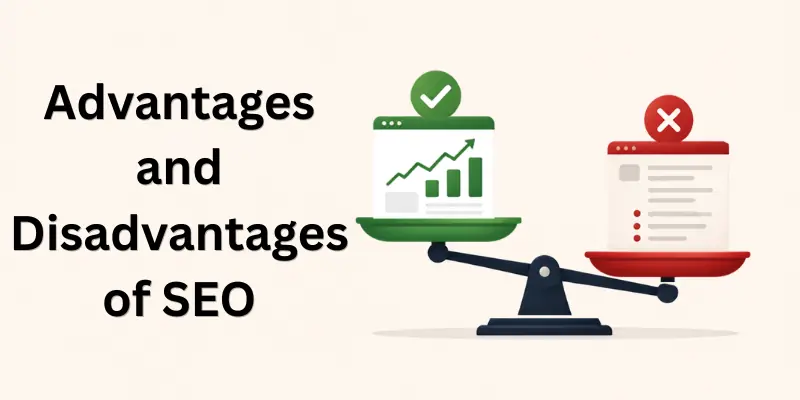
SEO Disadvantages
While SEO offers strong long-term value, it is not free of challenges. Some of these difficulties are not obvious to beginners at first.
Looking closely at the disadvantages of SEO helps you prepare for the realities of this strategy instead of expecting instant results.
- Time to Show Results
- Algorithm Updates
- Ongoing Efforts
- Ranking
- Technical Complexity
- Keyword Competition
- Skill or Investment
- Fluctuating Results
Here is a closer look at the common challenges that come with this strategy.
1. Time to Show Results
SEO rarely brings quick results. It usually takes weeks or months before a website starts ranking well. This waiting period can feel slow, especially for businesses that need faster growth.
Key Disadvantages:
- Slow initial progress
- Delayed visibility on search engines
- Patience required before results appear
2. Constant Algorithm
Search engines regularly update how they rank websites. A strategy that works today may need adjustments tomorrow. Staying updated becomes a constant task rather than a one-time effort.
Key Disadvantages:
- Frequent changes in ranking rules
- Need for ongoing adjustments
- Older strategies can lose effectiveness
3. Ongoing Effort
SEO is not a one-time task. Content needs updates, links need maintenance, and technical issues need regular checks. Stopping this effort can slowly reduce your rankings.
Key Disadvantages:
- Continuous maintenance needed
- Risk of losing rankings without upkeep
- Time investment does not end quickly
4. Ranking
Even with the best practices, no one can promise a top ranking. Search engines consider many factors, and results can vary between websites and industries.
Key Disadvantages:
- Uncertain outcomes despite effort
- No fixed timeline for success
- Rankings depend on many changing factors
5. Technical Complexity
SEO involves more than writing good content. Site speed, mobile design, coding structure, and backend settings all play a role. This technical side can feel overwhelming for beginners.
Key Disadvantages:
- Steep learning curve for beginners
- Technical knowledge often required
- Mistakes can affect performance
6. Keyword Competition
Popular keywords often have many websites competing for the same spot. This makes it harder for new or smaller websites to rank quickly, especially in competitive industries.
Key Disadvantages:
- Difficult to rank for popular terms
- Slower progress in competitive niches
- Requires stronger content to compete
7. Skill or Investment
Doing SEO correctly takes either time to learn it yourself or money to hire someone who already understands it. Both paths require a real investment before results appear.
Key Disadvantages:
- Learning curve takes time
- Hiring experts adds cost
- Mistakes can slow down progress
8. Fluctuating Results
Rankings can move up and down even after reaching a good position. A change in algorithm or new competition can affect a page that previously performed well.
Key Disadvantages:
- Rankings are not always stable
- Outside factors can affect performance
- Ongoing monitoring is necessary
The table below breaks down the SEO pros and cons in one simple view.
Comparison Table
Looking at both sides together can make the differences easier to understand.
| Aspect | SEO Advantage | SEO Disadvantage |
|---|---|---|
| Cost | Free organic traffic after setup | Requires upfront time or budget to build |
| Speed of Results | Long-lasting once achieved | Slow to appear, often takes months |
| Trust | Builds strong brand credibility | Rankings can drop without warning |
| Maintenance | Supports long-term growth | Needs regular updates and monitoring |
| Competition | Strong edge over non-optimized sites | Harder to rank in competitive niches |
| Skill Needed | Improves with practice over time | Steep learning curve for beginners |
A quick comparison like this makes it easier to weigh your options. But there are situations where SEO alone may not be the right fit for your needs.
When SEO is Not the Answer
SEO works best as a long-term strategy, so it is not always suitable for businesses that need immediate visibility. A new store launching a limited-time offer, or a business needing sales within days, may not have the time to wait for organic rankings to build.
In such cases, businesses often turn to alternatives to SEO, such as paid search ads, social media marketing, or influencer partnerships, to gain faster visibility. These options can bring quicker traffic, though they usually stop once the spending stops. Choosing between SEO and other methods depends on your timeline, budget, and business goals.
Knowing when to explore other options does not mean SEO holds no value. It simply means every business has different needs, and understanding those needs helps you make a smarter choice.
How to Maximize the Advantages and Reduce the Disadvantages of SEO
SEO becomes easier to manage when you follow a few practical habits. Small, consistent actions often matter more than one-time bursts of effort.
- Publish quality content regularly: Keeps your website relevant and updated in the eyes of search engines.
- Focus on user experience: A fast, mobile-friendly site keeps visitors engaged longer.
- Track keyword performance: Helps you understand what is working and what needs adjustment.
- Build genuine backlinks: Strengthens your site authority over time.
- Stay updated on algorithm changes: Helps you adapt your strategy before rankings drop.
- Fix technical issues promptly: Prevents small problems from affecting your overall performance.
- Be patient with the process: Reduces frustration during the early stages.
- Combine SEO with other channels: Balances the slower nature of organic growth with faster results elsewhere.
These small steps can make a real difference in how SEO performs for you over time. Now let us look at who can benefit most from using this strategy.
Who Should Use SEO
SEO fits businesses and individuals who are ready to invest time in steady, long-term growth. It works well for anyone willing to stay consistent and adapt as search trends change.
- Business owners building a long-term online presence
- Bloggers and content creators aiming for consistent traffic
- Startups working with a limited marketing budget
- E-commerce stores wanting sustainable visibility
- Freelancers and agencies offering digital marketing services
If you see yourself in this list, the next step is understanding how to move forward with a clear and confident plan.
Final Decision
A clear understanding of the advantages and disadvantages of SEO helps you avoid confusion and build a strategy with more confidence. Every method has its strengths and its limits, and SEO is no exception. Weighing the search engine optimization pros and cons honestly puts you in a better position to plan your next move.
Success with SEO depends on consistency, patience, and a willingness to keep learning as search engines evolve. The way you apply these lessons matters more than expecting instant results. Now it is your turn to decide.
Think about your timeline, your budget, and your goals before choosing your path. A few common questions can help clear up any remaining doubts.
FAQs
Still unsure about a few details? Here are answers to some of the most common questions people ask about SEO.
The main search engine optimization advantages and disadvantages include long-term traffic growth and cost savings on one side and slow results with ongoing effort on the other.
SEO rewards patience and consistency rather than quick wins. Businesses that understand both sides tend to set more realistic expectations from the start.
Yes, SEO remains one of the most reliable ways to build lasting online visibility. Search engines continue to drive significant traffic to websites that follow updated best practices. While algorithms change often, the core idea of creating helpful, relevant content still drives results.
Most websites start seeing noticeable improvement within three to six months, though this can vary by industry and competition. Highly competitive niches often take longer. Consistent effort during this period plays a major role in how quickly results appear.
Beginners often struggle with the technical side of SEO, along with the wait time before results appear. Understanding SEO cons early, such as algorithm changes and ranking uncertainty, helps avoid frustration. Learning gradually and focusing on fundamentals makes the process much smoother.
Yes, small businesses often gain strong value from SEO because it does not require a large advertising budget. Local SEO in particular helps nearby customers find a business easily. Over time, this can create a steady stream of leads without ongoing ad costs.
Businesses looking for faster results sometimes turn to paid search ads, social media marketing, or email campaigns. These channels can work well alongside SEO rather than replacing it completely. The right mix usually depends on budget, timeline, and business goals.
Neither option is better in every situation, since each serves a different purpose. SEO builds long-term, sustainable traffic, while paid ads bring faster but temporary visibility. Many businesses use both together to balance speed and long-term growth.
The general pros and cons of search engine optimization apply across most industries, though the impact can vary. Highly competitive fields may take longer to see results, while niche industries can rank faster. Understanding your specific market helps you set a realistic SEO timeline.




- Be Respectful
- Stay Relevant
- Stay Positive
- True Feedback
- Encourage Discussion
- Avoid Spamming
- No Fake News
- Don't Copy-Paste
- No Personal Attacks
- Be Respectful
- Stay Relevant
- Stay Positive
- True Feedback
- Encourage Discussion
- Avoid Spamming
- No Fake News
- Don't Copy-Paste
- No Personal Attacks
