Types of SEO: A Simple Guide to Every Category for Beginners
Published: 7 Aug 2026
Imagine spending hours writing what feels like the perfect blog post, only to watch it sit quietly on page ten of Google while a shorter, weaker article ranks right at the top. Frustrating, right? Most people blame the content itself, but the real answer is usually something much simpler. They are missing out on the right mix of SEO strategies.
This is exactly why the types of SEO matter so much. Each type plays its own role, and knowing when to use which one can be the difference between a website that grows steadily and one that stays invisible. This guide breaks every major type down in plain, simple language, so you know exactly what each one does and where it fits.
Different Types of SEO
Before jumping into the details, it helps to understand one simple idea. SEO is never just one task done once. It is a mix of ongoing strategies, and each one supports a different part of how a website performs online.
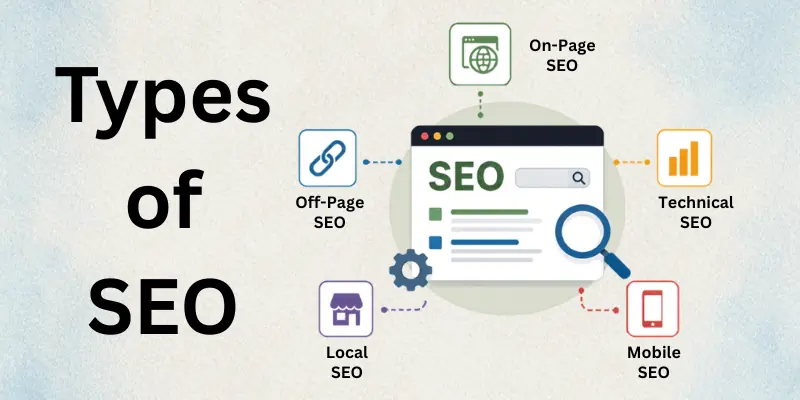
Now let us go through the different types of SEO one by one, with clear examples for each.
1. On-Page SEO
On-page SEO means optimizing the content and elements that sit directly on a webpage. It helps search engines understand what the page is about and helps readers find value fast.
- Uses keywords inside titles, headings, and body text
- Focuses on content quality and readability
- Improves internal linking between related pages
- Optimizes meta titles and descriptions
- Matches the actual intent behind a search
Examples:
- A blog post structured around one main keyword
- A product page with a clear, keyword-rich title
- A service page with proper heading tags
2. Off-Page SEO
Off-page SEO covers everything that happens away from a website but still affects how well it ranks. It builds trust and authority through outside signals.
- Focuses on backlinks from other websites
- Builds brand mentions across the web
- Includes social shares and influencer mentions
- Strengthens domain authority over time
- Acts as a trust signal for search engines
Examples:
- A guest post linking back to your site
- A brand mention inside a news article
- Social media shares of a published article
3. Technical SEO
Technical SEO deals with the backend structure of a website. It makes sure search engines can crawl, read, and index every page without running into problems.
- Improves site speed and loading time
- Fixes crawl errors and broken links
- Manages sitemaps and robots.txt files
- Ensures the site works well on mobile
- Supports secure browsing through HTTPS
Examples:
- Speeding up a slow-loading homepage
- Setting up a clean XML sitemap
- Removing duplicate content across pages
4. Local SEO
Local SEO helps businesses show up in searches from people nearby. It works especially well for shops, clinics, and service providers with a physical address.
- Optimizes a Google Business Profile listing
- Focuses on location-based keywords
- Builds local citations and customer reviews
- Improves visibility inside map results
- Targets nearby customers directly
Examples:
- A cafe appearing in “coffee shops near me”
- A dentist ranking inside local map results
- A salon showing up in city-based searches
5. E-commerce SEO
E-commerce SEO focuses on optimizing online stores so products get discovered easily. It helps increase visibility across both product and category pages.
- Optimizes product titles and descriptions
- Improves category page structure
- Targets buyer-intent keywords
- Enhances product images with alt text
- Supports stronger conversion rates
Examples:
- A Shopify store refining its product listings
- An online clothing store improving category pages
- A seller writing clearer product descriptions
6. Mobile SEO
Mobile SEO makes sure a website performs well on phones and tablets. Since most searches now happen on mobile devices, this type has become essential rather than optional.
- Focuses on responsive website design
- Improves mobile loading speed
- Simplifies navigation for smaller screens
- Avoids intrusive pop-ups on mobile
- Supports a smoother mobile experience
Examples:
- A website that resizes cleanly on a phone
- Fast-loading mobile product pages
- Easy-to-tap buttons and menus
7. Voice Search SEO
Voice search SEO optimizes content for spoken queries used with tools like Siri, Alexa, or Google Assistant. It focuses on natural, conversational phrasing rather than short keywords.
- Targets question-based search terms
- Uses natural, conversational language
- Focuses on earning featured snippets
- Improves quick-answer style content
- Matches how people actually speak
Examples:
- Content answering “What is the best bakery near me”
- FAQ sections written in a conversational tone
- Pages built around quick voice answers
8. International SEO
International SEO helps websites rank across multiple countries or languages. It focuses on reaching the right audience based on both location and language.
- Uses hreflang tags for language targeting
- Creates country-specific content
- Adjusts keywords for regional searches
- Supports multiple currencies and languages
- Improves visibility across global markets
Examples:
- A brand website with separate country pages
- A store offering content in several languages
- A business targeting both the US and UK separately
9. Content SEO
Content SEO focuses on creating valuable content that satisfies what a searcher is truly looking for. It works closely with on-page SEO but centers fully around the writing itself.
- Focuses on search intent and topic depth
- Builds related content around one theme
- Improves overall readability and structure
- Updates older content to stay relevant
- Encourages readers to stay longer on a page
Examples:
- A detailed guide answering one clear question
- A blog series covering related subtopics
- An older article refreshed with new information
10. Enterprise SEO
Enterprise SEO applies to large websites with thousands of pages, such as big brands or platforms. It focuses on scale, automation, and managing SEO across many teams at once.
- Manages SEO across a large volume of pages
- Uses automation and reporting tools
- Coordinates across multiple departments
- Focuses on brand-wide visibility
- Requires a strong technical foundation
Examples:
- A large retail brand managing thousands of product pages
- A media company optimizing hundreds of articles
- A software company scaling content across regions
These ten categories cover most of what falls under the different SEO forms used today, but people often want a simpler number to hold onto.
How Many Types of SEO Are There?
There is no single fixed number, which is exactly why people keep asking how many types of SEO actually exist. Different experts group them differently, but most agree the core categories fall somewhere between eight and twelve major types, close to what you just read above.
A few smaller sub-types also exist, such as image SEO or video SEO, but these usually sit inside bigger categories like on-page or content SEO. The exact count matters far less than actually understanding what each type does and when to use it.
Once the categories are clear, it helps to see how they come together in a real situation, such as building a single landing page.
Why Do SEO Types Matter When Building a Landing Page?
A landing page is one of the clearest places where several SEO types work together at the same time. Writing good content alone is never enough. The page also needs a solid technical base and the right supporting signals around it.
- On-page SEO shapes the headline, structure, and keyword placement
- Technical SEO makes sure the page loads fast and works on mobile
- Content SEO ensures the page matches what the visitor is actually searching for
- Off-page SEO builds trust through backlinks pointing to the page
- Local SEO helps if the page targets a specific city or region
Without this mix working together, a landing page might look polished but still fail to rank or convert. This shows that SEO types are not just theory. They directly shape real business results.
Seeing this in action naturally raises another question. With so many options, how does anyone decide which type to actually focus on first?
How to Choose the Right Type of SEO for Your Goals
There is no single type that works best for everyone. The right choice depends on the website, the audience, and what the business is actually trying to achieve.
- Start with on-page and content SEO if your website is new
- Prioritize local SEO if you serve one specific city or area
- Focus on technical SEO first if your site struggles with speed
- Add off-page SEO once your content foundation feels solid
- Combine two or three types together for steady, long-term growth
Instead of trying to master everything at once, most successful websites grow by focusing on one strong type first and expanding from there.
Choosing the right type is only part of the picture. The person applying these strategies also needs a certain set of skills to make them work.
Key SEO Skills
No matter which category you focus on, a few core SEO skills make every type of SEO easier to apply and far more effective.
- Keyword Research: Finding what people actually search for
- Analytical Thinking: Reading data from tools like Google Search Console
- Content Writing: Creating clear, valuable, and readable material
- Basic Technical Knowledge: Understanding how websites and CMS platforms work
- Outreach Skills: Building relationships for backlinks and mentions
- Patience and Consistency: Accepting that most SEO results take time
- Adaptability: Adjusting quickly when search engines update their algorithms
These skills apply across every category, whether someone is working on technical fixes or writing a single blog post.
These skills can also become easier once you see how SEO itself has changed over the years.
Brief History of SEO
SEO did not always look the way it does today. It slowly changed as search engines became smarter and stricter about what counts as quality.
- Early Keyword Era: Websites stuffed pages with repeated keywords to rank
- Link-Building Boom: Backlinks became the main ranking signal for years
- Content Quality Shift: Search engines began rewarding genuinely useful content
- Mobile-First Era: Websites had to adapt fully to smartphone users
- Local Search Rise: Location-based results became far more important
- Voice and AI Era: Conversational and question-based content started ranking better
- Present-Day Search: AI-driven results now shape how different SEO types are applied
Looking at this SEO timeline makes it clear that SEO has always adjusted to how people actually search, and it will likely keep changing in the same way.
Final Thoughts
At the end of the day, the types of SEO are not separate, unrelated tools sitting on a shelf. They work together, each one covering a gap the others cannot. A website with strong content but poor technical health will still struggle, just as a technically perfect site with weak content will fail to hold anyone’s attention.
If there is one thing worth remembering, it is this. Growth rarely comes from doing everything at once. It comes from picking the right starting point, staying consistent, and slowly building outward. That single decision often shapes whether a website grows quietly in the background or keeps struggling to be seen at all.
Before you go, here are a few quick answers to the questions people ask most often about this topic.
Frequently Asked Questions
If you still have a few doubts, these quick answers about SEO types help clear things up.
The main search engine optimization types include on-page, off-page, and technical SEO. Local, e-commerce, and content SEO are also widely used depending on the business.
Together, these cover most of what a website needs to rank well. Beginners usually start with on-page and content SEO first.
Online stores mostly rely on e-commerce, technical, and content SEO together. These different types of search engine optimization help product pages rank properly and load fast.
Local SEO can also help stores that have a physical branch. Combining these types usually leads to stronger visibility and sales.
The easiest kinds of SEO to start with are on-page and content SEO. Both are beginner-friendly and do not require deep technical knowledge.
Once comfortable, learners usually move into technical or local SEO next. Building one skill at a time makes the whole process far less overwhelming.
Most businesses invest heavily in SEO categories like technical, content, and local SEO. Larger companies often add off-page and e-commerce SEO as they scale further.
The right mix always depends on the size and goals of the business. Smaller businesses usually see faster results by staying focused on fewer categories.
SEO services usually match the categories covered earlier in this guide, just offered as packages. Common ones include technical audits, local SEO management, e-commerce optimization, content writing, and link-building campaigns.
Some agencies also offer full strategy and consulting services. The right service depends entirely on what a specific website actually needs.
There is no single best type, since the right choice depends on the website and its goals. A local bakery does not need the same approach as a global software company.
On-page and content SEO usually work as the strongest starting point for most beginners. Long-term success typically comes from blending a few types together rather than relying on just one.
Most SEO strategies take anywhere from three to six months to show noticeable results. Technical fixes can sometimes show faster improvements within a few weeks.
Content and off-page SEO usually need more time to build authority. Staying consistent matters far more than expecting instant results.
Yes, especially for smaller websites with simpler needs. Many beginners successfully manage on-page, content, and basic technical SEO on their own.
Larger or more competitive websites often need extra help as tasks become more complex. Starting alone and expanding later is a completely normal path to take.





- Be Respectful
- Stay Relevant
- Stay Positive
- True Feedback
- Encourage Discussion
- Avoid Spamming
- No Fake News
- Don't Copy-Paste
- No Personal Attacks
- Be Respectful
- Stay Relevant
- Stay Positive
- True Feedback
- Encourage Discussion
- Avoid Spamming
- No Fake News
- Don't Copy-Paste
- No Personal Attacks
