Importance of Blogging: Why It Matters More Than Ever
Published: 24 Jul 2026
Why do some websites keep attracting readers months after publishing, while others struggle to get attention even after regular promotion? The difference is often not a bigger budget or more social media posts. It is the ability to publish helpful content that people continue to search for, read, and trust.
The importance of blogging becomes clear when you want more than temporary traffic. A useful blog can answer customer questions, improve search visibility, build authority, and guide readers toward your products or services. But its real power goes even deeper. Every strong article becomes a long-term digital asset that can keep supporting your website even when you are not actively promoting it.
Blogging Importance
People search online because they need answers, ideas, comparisons, or solutions. A useful blog helps a brand appear during those moments and gives readers enough information to make a confident decision.
Google also recommends creating helpful, reliable, people-first content instead of publishing pages mainly to influence search rankings.
- Builds Search Visibility
- Creates Lasting Website Traffic
- Shows Knowledge and Experience
- Educates Potential Customers
- Strengthens Brand Personality
- Supports Lead Generation
- Builds Reader Trust
- Creates Reusable Content
- Develops Audience Relationships
- Supports Steady Growth
But how does each benefit work in practice? Let’s look at the main reasons blogs remain useful for individuals and businesses.
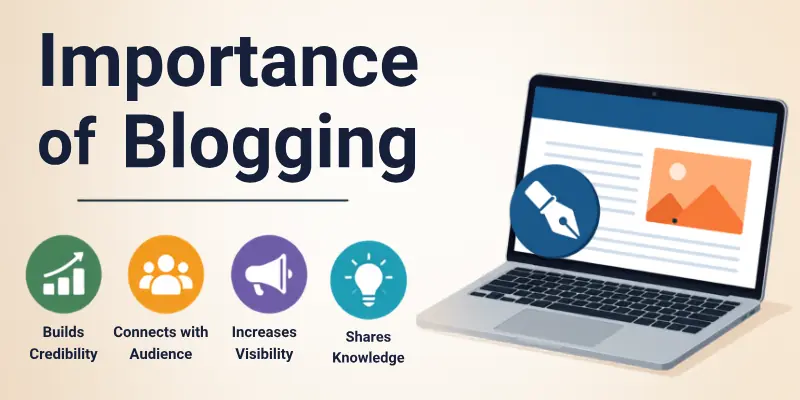
Builds Search Visibility
Every useful post gives search engines another page to understand and users another way to discover your website. A focused article can answer a specific question that may not fit naturally on your homepage or service pages.
- Targets clear search topics
- Covers detailed customer questions
- Creates internal linking opportunities
- Helps relevant pages get discovered
Creates Lasting Website Traffic
A social post may receive attention for a short time, but a helpful blog post can continue attracting readers long after it is published. Older posts can also be refreshed when information, examples, or search needs change.
- Works beyond the publishing day
- Brings visitors without daily promotion
- Gains strength as related content grows
- Can be updated instead of replaced
Recent marketing research also shows that many marketers continue to see stronger returns from blogging, supporting its role as a long-term content channel.
Shows Knowledge and Experience
Readers trust information more when it is clear, practical, and based on real understanding. Blogging gives you enough space to explain your process, share lessons, discuss common mistakes, and show how you approach problems.
- Demonstrates subject knowledge
- Shares useful personal experience
- Explains difficult ideas simply
- Builds professional credibility
Educates Potential Customers
Many people are not ready to buy during their first visit. They may need to understand the problem, compare choices, or learn how a service works.
Blog content can guide them through this process without making every paragraph feel like a sales message.
- Answers early-stage questions
- Explains products and services
- Reduces repeated customer confusion
- Supports better buying decisions
Strengthens Brand Personality
A blog gives your brand room to sound human. It can show your beliefs, communication style, priorities, and way of thinking.
Over time, readers begin to recognize not only what you offer but also how you approach your work.
- Creates a familiar writing style
- Shows the people behind the brand
- Communicates values clearly
- Makes the business more memorable
Supports Lead Generation
A useful article can attract someone through search, solve part of their problem, and then offer a sensible next step.
That step may be joining an email list, downloading a guide, booking a call, requesting a quote, or exploring a related service.
- Attracts people with clear needs
- Connects information with an offer
- Uses relevant calls to action
- Moves readers into the customer journey
Builds Reader Trust
Trust grows when content is accurate, balanced, and genuinely helpful. A blog allows you to address concerns openly, explain limitations, and give readers useful information before asking them to make a commitment.
- Reduces uncertainty
- Answers real concerns
- Shows honest expertise
- Creates confidence over time
Creates Reusable Content
One detailed article can support several other marketing channels. Its main ideas can become an email, short video, social post, checklist, podcast discussion, infographic, or part of a sales presentation.
- Saves content-planning time
- Keeps marketing messages connected
- Supports different content formats
- Extends the life of one idea
Develops Audience Relationships
Blogging is not only about attracting new visitors. It can also give existing readers a reason to return. Publishing useful insights regularly creates familiarity and encourages people to stay connected with your brand.
- Encourages repeat visits
- Supports email conversations
- Creates community discussions
- Keeps the audience informed
Supports Steady Growth
A useful content library becomes more valuable as it expands. New articles can connect with older ones, answer deeper questions, and support different stages of the reader journey. This growing effect is one reason blogging can continue producing results long after individual posts are published.
- Builds a growing digital resource
- Supports several marketing goals
- Improves content depth over time
- Creates long-term business assets
Before moving ahead, remember this: a blog works best when every article has a clear purpose. Now, let’s see how it supports the wider digital marketing system.
Importance of Blogging in Digital Marketing
Digital marketing depends on useful information. People may discover a brand through search, email, social media, videos, paid ads, or an AI-powered search experience, but they still need a reliable page where they can learn more.
The significance of blogging in digital marketing comes from its ability to connect these channels. A blog can act as the main source of detailed information while shorter platforms bring people back to it.
SEO Content: Creates focused pages that help search engines understand topics and help users find relevant answers.
Email Marketing: Gives subscribers helpful articles to read instead of sending only promotional messages.
Social Media: Provides ideas, quotes, tips, and discussions that can be adapted into shorter posts.
Video Marketing: Supplies research, examples, and structure for educational video scripts.
Lead Nurturing: Helps potential customers learn gradually before choosing a product or service.
Internal Linking: Connects related articles, guides, service pages, and product pages in a logical path.
Content Repurposing: Turns one detailed article into several formats for different audiences and platforms.
Brand Search: Gives people more useful pages to explore when they search for your name or business.
AI Search Visibility: Provides clear, indexable, and well-structured information that may be discovered through modern search experiences. Google’s current guidance says that core SEO practices remain relevant to AI Overviews and AI Mode.
Campaign Support: Gives advertisements, product launches, and promotions a helpful destination with additional context.
Digital marketing becomes stronger when every channel supports the others. A blog can become the central knowledge base that keeps those messages useful and connected.
Small businesses often need this kind of long-term resource because they cannot always depend on large advertising budgets. Let’s look at how blogging helps them compete.
Importance of Blogging for Small Businesses
Small businesses need practical marketing that builds visibility without requiring constant spending. A helpful blog allows them to answer local questions, explain their expertise, and attract people who are already searching for a solution.
This is why blogging matters for smaller brands: it gives them space to compete through knowledge, clarity, and usefulness instead of budget alone.
Local Discovery: Creates articles around local needs, services, events, and customer questions.
Affordable Promotion: Builds an owned content library that does not disappear when an advertising campaign ends.
Service Explanation: Provides enough space to explain processes, pricing factors, timelines, and expected results.
Customer Confidence: Shows that the business understands the problems its customers face.
Niche Authority: Helps a small company become known for a specific subject, product, or service.
Sales Support: Gives team members useful pages to share with interested customers.
Frequently Asked Questions: Turns repeated customer questions into searchable and helpful articles.
Community Connection: Allows the business to discuss local issues, events, and relevant industry changes.
Competitive Positioning: Shows the differences between the business and larger or similar competitors.
Future Growth: Creates content that can continue supporting new services, locations, and audiences.
A small business blog does not need a new post every day. It needs useful articles written around genuine customer needs.
Quality, clarity, and consistency matter more than publishing content simply to stay active.
The same approach can also help individuals who sell their skills, ideas, or expertise. Now, let’s see how blogging supports freelancers and personal brands.
Importance of Blogging for Freelancers and Personal Brands
Freelancers often need to prove their ability before a client begins a conversation. A blog can do this quietly by showing how they think, what they know, and how they solve problems.
Visible Expertise: Shows knowledge through useful explanations instead of unsupported claims.
Stronger Portfolio: Adds context to projects, working methods, decisions, and final outcomes.
Better Client Fit: Attracts people who already connect with the freelancer’s approach and ideas.
Personal Brand Voice: Creates a recognizable style that makes the writer easier to remember.
Searchable Skills: Builds pages around services, tools, industries, and common client problems.
Proposal Support: Gives freelancers relevant articles to include in proposals or follow-up messages.
Higher-Value Positioning: Moves attention away from price alone and toward knowledge, experience, and strategy.
Professional Growth: Encourages research, reflection, and clearer thinking about the freelancer’s field.
Networking Opportunities: Gives peers and potential partners useful work to discuss or share.
Independent Audience: Reduces complete dependence on freelance platforms and social media algorithms.
Blogging can turn private knowledge into visible proof. But when a business or professional ignores it completely, several long-term opportunities may be lost.
What Happens When Businesses Ignore Blogging?
The impact of blogging is often easiest to notice when a website has no educational content. Visitors may find a homepage and service page, but they cannot explore detailed answers, examples, comparisons, or guidance.
As a result, they may leave the website and continue their research somewhere else.
A missing or neglected blog can also weaken other marketing efforts. Social posts have fewer useful pages to link to, emails become more promotional, and sales teams have less educational material to share.
Competitors that publish clearer and more useful answers may become more visible and trusted over time.
Key Problems
- Fewer search entry points
- Limited customer education
- Weak proof of expertise
- Greater dependence on paid promotion
- Less reusable marketing content
- Fewer reasons for visitors to return
Sometimes a website does not need more features. It simply needs better answers. Let’s bring the main lessons together.
Conclusion
This guide to the importance of blogging shows that a blog can support visibility, customer education, trust, lead generation, and long-term brand growth. Its biggest strength is not the number of posts published. It is the ability to create useful resources that people can find, understand, and return to.
Start with real audience questions. Choose one clear purpose for every article, use simple language, and update important posts when information changes. Avoid publishing thin, repetitive, or confusing content only to target keywords. Google’s current guidance continues to emphasize accuracy, relevance, quality, and content created primarily for people.
A good blog grows one helpful answer at a time. So, the next time someone visits your website, ask yourself one important question: will they find only a service page, or will they discover a useful resource that gives them a reason to trust you, remember you, and return?
FAQs
Still wondering whether a blog deserves your time? These quick answers will clear your final doubts and help you understand where blogging fits into your goals.
Blogging gives a business more space to answer customer questions, explain services, and show expertise.This is why blogging is important for websites that need to educate visitors before asking them to purchase something.
A well-planned blog supports both customer understanding and conversions without making every page feel promotional.
Blog posts can target specific topics and questions that people search for. They also create opportunities for internal links, descriptive headings, and detailed answers.
However, posts should be useful and original because search visibility is not guaranteed simply by publishing more pages. Google recommends helping users first while making content easy for search engines to understand.
Yes, helpful posts can attract visitors through organic search, email sharing, referrals, and social media. Some readers may later become leads or customers.
Results usually grow gradually, so blogging should be treated as a long-term marketing channel rather than an instant replacement for advertising.
A beginner should choose a schedule that provides enough time for research, writing, editing, and updates. One strong article every week or every two weeks may be more useful than several rushed posts. The right frequency depends on the topic, available resources, audience needs, and business goals.
A business blog should cover customer questions, common mistakes, comparisons, how-to guidance, industry changes, product uses, and decision-making concerns.
The best ideas usually come from sales calls, support messages, search queries, reviews, and conversations with real customers.
No. Some posts should educate readers, build trust, or help people solve a small problem. A relevant call to action can still guide readers to another article, email signup, service page, product, or useful resource. The next step should match the reader’s reason for visiting the page.
Yes. Google states that foundational SEO practices remain relevant for AI-powered search features. Clear, accurate, well-structured, and indexable content can still help people discover a website through traditional and generative search experiences. Inclusion is not guaranteed, so the main focus should remain on genuinely useful content.
There is no fixed timeline. Results depend on competition, website condition, content quality, topic demand, promotion, and publishing consistency.
Some articles may gain attention quickly, while others build traffic over several months. Tracking impressions, clicks, engagement, leads, and conversions provides a clearer picture of progress.





- Be Respectful
- Stay Relevant
- Stay Positive
- True Feedback
- Encourage Discussion
- Avoid Spamming
- No Fake News
- Don't Copy-Paste
- No Personal Attacks
- Be Respectful
- Stay Relevant
- Stay Positive
- True Feedback
- Encourage Discussion
- Avoid Spamming
- No Fake News
- Don't Copy-Paste
- No Personal Attacks
