History of Blogging: From Diaries to Digital Empires
Published: 26 Jul 2026
Have you ever wondered how a simple online journal turned into one of the biggest forms of communication on the internet? Many beginners start a blog today without knowing the history of blogging or how it actually began. Because of this, they miss the story behind the tool they use every day.
I often see new bloggers focus only on traffic and monetization while ignoring where blogging came from. In this brief history of blogging, I will explain how it started, how it grew, and why understanding its roots still helps writers today.
Origins of Blogging
The origins of blogging go back to the early 1990s, when the internet itself was still new. A handful of tech-savvy people started publishing personal pages and online journals long before the word “blog” even existed. These early writers had no idea they were building the foundation of a whole new industry.
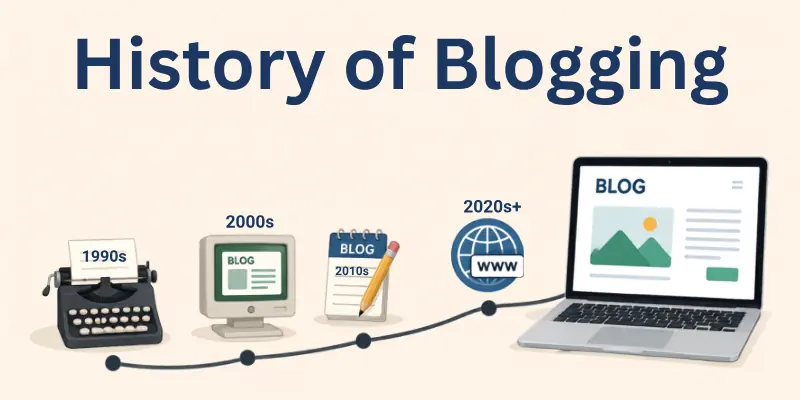
To understand this journey better, it helps to break blogging history into different eras. Each era brought new tools, new platforms, and new ways for people to express themselves online.
Eras of Blogging History
1. The Online Journal Era (1993 to 1996)
This is where the history of blogs truly begins. In the early 1990s, a small number of people started publishing plain-text journals on the web. There were no templates, no design, and no comment sections. It was simply text on a page, updated by hand.
I find this era fascinating because it shows that the desire to share personal thoughts online existed long before blogging had a name or a proper platform.
- Early online journals were written in plain text.
- Rob Palmer is often credited as one of the earliest online journal writers, starting in late 1993.
- Justin Hall launched his site Links.net in January 1994, later called the “founding father of personal bloggers.”
- Pages had no graphics or fancy formatting.
- These journals laid the groundwork for personal blogging.
2. The Naming Era (1997 to 1998)
Before this period, nobody used the word “blog.” People simply called these pages “online diaries” or “personal home pages.” This changed when a new term was introduced that finally gave the format an identity.
I think this era matters because giving something a name is often the first step toward turning it into a real movement.
- Jorn Barger coined the term “weblog” in December 1997 on his site Robot Wisdom.
- Early “weblogs” mostly linked to other interesting pages with short comments.
- Tech-focused sites like Slashdot launched in 1997.
- Journalist Jonathan Dube published one of the first blog-style news posts in 1998.
- The community around weblogs slowly started to grow.
3. The Platform Birth Era (1999)
The word “blog” as we know it today came from this short but important period. New tools also appeared that let ordinary people publish online without needing to know any code.
From what I have read, this era changed everything because it removed the technical barrier that had kept most people from blogging.
- Programmer Peter Merholz shortened “weblog” to simply “blog” in 1999.
- Evan Williams and Meg Hourihan launched Blogger in August 1999.
- Brad Fitzpatrick started LiveJournal in March 1999.
- Xanga also launched in 1999, later adding blogging features.
- Publishing online finally became easy for non-programmers.
4. The Growth and Community Era (2000 to 2002)
Once blogging tools became available to everyone, the number of blogs grew quickly. People started connecting with each other through comments, links, and shared interests. Blogging stopped being a solo activity.
I always find this stage important because it shows how blogging moved from personal writing to a real online community.
- Open Diary introduced reader comments, one of the first blog communities.
- Adam Kontras posted one of the earliest video blog entries in January 2000.
- Political blogs started gaining attention around 2001.
- Technorati launched in 2002 as one of the first blog search engines.
- Blogrolls and permalinks helped bloggers link to one another.
5. The Mainstream and Monetization Era (2003 to 2006)
This period brought blogging into the mainstream. New tools made design and publishing easier, and for the first time, people realized they could actually earn money from their blogs.
I see this era as a turning point because blogging shifted from a hobby into something people could treat as a business.
- WordPress launched its open-source platform in 2003.
- Google acquired Blogger‘s parent company, Pyra Labs, in 2003.
- Google AdSense allowed bloggers to start earning through ads.
- The Huffington Post and TechCrunch both launched in 2005.
- WordPress.com launched in 2006, making blogging even more accessible.
6. The Professional Blogging Era (2007 to 2011)
By this stage, blogging had become a serious career option for many people. Businesses also started using blogs as a marketing tool, not just individuals sharing personal stories.
I believe this era gave blogging its professional identity, similar to how other writing fields eventually became recognized careers.
- Tumblr launched in 2007, introducing short-form microblogging.
- By 2010, around 11% of bloggers reported blogging as their main income source.
- Google’s Panda update in 2011 pushed bloggers to focus on quality content.
- Guest blogging and SEO writing became common practices.
- Brands began hiring bloggers for sponsored content.
7. The Social and Multimedia Era (2012 to 2019)
As social media platforms grew, blogging had to adapt. Bloggers started adding more images, videos, and interactive content to keep readers engaged, since attention was now split across many platforms.
From my view, this era proves that blogging survives by evolving alongside new technology instead of competing against it.
- Medium launched in 2012 as a modern publishing platform.
- LinkedIn opened blogging features to all users in 2014.
- WordPress introduced the .blog domain extension in 2017.
- Video content and vlogs grew rapidly alongside written blogs.
- Mobile-friendly blog design became a necessity.
8. The AI and Modern Blogging Era (2020 to Present)
The current stage of blogging blends human creativity with new writing tools. Bloggers now use technology to speed up research and content planning, but the core skill of connecting with readers still comes from real human insight.
I have noticed that even with new tools available, readers still prefer blogs that sound genuine and helpful rather than robotic.
- AI tools now assist with research, outlines, and editing.
- SEO and search intent play a bigger role in blog planning.
- Authenticity and personal experience are valued more than ever.
- Short-form and long-form blogs both continue to perform well.
- Human judgment still guides the final quality of content.
These eras show how blogging changed step by step, but the story is not complete without looking at the people who shaped it. So, who invented blogging, and which names actually built this industry?
Who Shaped the History of Blogging
Blogging did not grow on its own. A handful of individuals introduced ideas, platforms, and terms that changed everything. Here are some of the names that shaped this field:
- Justin Hall – Widely credited with one of the earliest personal blogs, Links.net, in 1994.
- Jorn Barger – Coined the term “weblog” in 1997.
- Peter Merholz – Shortened “weblog” to “blog” in 1999.
- Evan Williams – Co-founded Blogger, one of the first major blogging platforms.
- Brad Fitzpatrick – Created LiveJournal, an early blogging community.
- Matt Mullenweg and Mike Little – Built WordPress, now the most popular blogging platform in the world.
- Arianna Huffington – Brought blogging into mainstream news with The Huffington Post.
- Matt Drudge – Used a news-style weblog format to influence political reporting early on.
These pioneers changed how people write and publish online, but seeing their work laid out on a timeline makes the full picture even clearer.
History of Blogging Timeline Table
This history of blogging timeline gives a simple, step-by-step view of how blogging evolved over the years.
| Era | Time Period | Simple Explanation |
|---|---|---|
| Online Journal Era | 1993 – 1996 | People began publishing plain-text personal journals online. |
| Naming Era | 1997 – 1998 | The term “weblog” was created to describe these journal-style pages. |
| Platform Birth Era | 1999 | “Blog” became the short form, and the first blogging platforms launched. |
| Growth & Community Era | 2000 – 2002 | Comments, blogrolls, and search tools helped bloggers connect. |
| Mainstream & Monetization Era | 2003 – 2006 | WordPress launched, and bloggers started earning through ads. |
| Professional Blogging Era | 2007 – 2011 | Blogging became a real career, and brands began using it for marketing. |
| Social & Multimedia Era | 2012 – 2019 | Blogs adapted with video, mobile design, and new publishing platforms. |
| AI & Modern Blogging Era | 2020 – Present | AI tools support writing, but human insight still leads the content. |
This blogging timeline shows how a simple text-based habit turned into a worldwide form of communication. Each stage added something new, and the next shift is already underway.
How AI is Shaping the Future of Blogging
Blogging keeps changing as new tools make writing and research faster. Many bloggers now use AI to brainstorm ideas, outline posts, or edit drafts, which saves time on repetitive tasks.
From my perspective, the real shift is in the workflow, not in the writer’s role. Readers still connect with real stories and honest opinions. Tools only speed up the process; they do not replace the human voice behind a blog.
- AI helps bloggers research topics faster.
- Content planning has become more efficient.
- Writers spend more time on strategy and originality.
- Reader trust still depends on authentic, human writing.
- Technology supports blogging but does not replace it.
Conclusion
In this guide, we covered the full history of blogging, showing how blogging began and grew into what it is today. From simple online journals in the early 1990s to AI-assisted writing in 2026, blogging has constantly adapted to new technology while keeping its core purpose alive: letting people share their voice with the world.
The tools and platforms will keep changing, but the heart of blogging stays the same: real people sharing real experiences. If we focus only on trends, we may lose sight of that. If we ignore new tools completely, we may fall behind. The best approach is to respect where blogging came from while adapting to where it is going.
Don’t miss the FAQs ahead. They cover some of the most common questions about blogging’s past, and skipping them could mean missing out on useful details.
FAQs
Here are some of the most searched questions about the history of blogging, answered simply.
Blogging is believed to have begun in the early 1990s, with some of the earliest online journals appearing around 1993 and 1994.
At that time, there was no official term for it, and pages were simple text with no design elements. It slowly grew from a small group of internet users into a widespread form of writing.
No single person is officially credited with inventing blogging, since it developed gradually. However, Justin Hall is often recognized for one of the earliest personal blogs, while Jorn Barger coined the term “weblog” in 1997. Together, early pioneers like these shaped what blogging became.
The origin of blogging traces back to personal online journals created by early internet users who wanted a space to share their thoughts and links.
These pages were not called “blogs” at first, but they carried the same purpose blogs serve today: personal expression and information sharing.
Blogging was not invented in a single moment. It evolved gradually, starting with early online journals in 1993 and 1994, followed by the term “weblog” in 1997, and finally shortened to “blog” in 1999, when the first blogging platforms launched.
Blogs originated from personal home pages and online diaries created by early internet users. As more people started publishing similar content, the practice was eventually grouped under the term “weblog,” which later became “blog.”
Blogging started with small groups of tech-savvy users publishing plain-text journals online in the early 1990s. As tools improved and platforms like Blogger and LiveJournal launched in 1999, blogging became accessible to everyday people, not just programmers.
There is some debate over this, but Justin Hall’s Links.net, launched in January 1994, is widely considered one of the earliest and most influential blogs. It featured his personal thoughts along with links to other websites he found interesting.
Blogging has moved from plain-text personal journals to a full industry that includes business marketing, professional writing, video content, and now AI-assisted tools.
While the format has changed many times, the core idea of sharing genuine content with readers has remained the same.






- Be Respectful
- Stay Relevant
- Stay Positive
- True Feedback
- Encourage Discussion
- Avoid Spamming
- No Fake News
- Don't Copy-Paste
- No Personal Attacks
- Be Respectful
- Stay Relevant
- Stay Positive
- True Feedback
- Encourage Discussion
- Avoid Spamming
- No Fake News
- Don't Copy-Paste
- No Personal Attacks
