Advantages and Disadvantages of Blogging in 2026 for Beginners
Published: 22 Jul 2026
Many people start a blog after hearing that it can bring traffic, customers, and income. But does every blog reach these results? And what problems appear after the first few posts are published?
The advantages and disadvantages of blogging show what you may gain and what you may face along the way. Blogging can help you share knowledge, reach readers, support a business, and build an online presence. It can also require time, regular work, updates, and patience.
This article covers both sides so you can decide whether blogging fits your goals, skills, and available time.
Blogging Pros
A blog is a digital asset that can become more useful as you continue adding valuable content. Unlike a short social media update, a well-written article can remain available to readers for months or years.
The following blogging advantages show why people, creators, professionals, and companies continue to invest in useful written content.
- Control Over Content
- Search Visibility
- Audience Trust
- Customer Education
- Long-Term Content Value
- Lead Generation
- Brand Voice
- Content Repurposing
- Knowledge Development
- Monetization Options
These are some of the strongest advantages of blogging for who are prepared to publish helpful content consistently.
1. Control Over Content
A personal or business blog gives you greater control over how your information is presented. You can choose the topics, writing style, page design, publishing schedule, and calls to action.
Social platforms can change their features or content rules, but a self-managed website gives you a more stable place for your work. You are not limited to short captions or fixed post formats.
This control makes it easier to organize information around your goals and create a clear experience for readers.
Key Advantages:
- Freedom to select relevant topics
- Greater control over presentation
- A permanent home for important content
2. Search Visibility
Blog posts can help search engines understand what a website offers. Every useful article creates another opportunity to answer a question that people are searching for.
Search optimization works best when content is created for real readers rather than written only to influence rankings. Google also explains that basic SEO can help search engines understand content and help users decide whether a page is useful to them.
Today, useful articles may appear through traditional results as well as AI-supported search experiences. Core SEO practices remain relevant, but the content still needs to offer clear and original value.
Key Advantages:
- More opportunities to appear in searches
- Better explanation of website topics
- Potential for steady organic discovery
3. Audience Trust
Helpful articles allow you to demonstrate knowledge instead of simply claiming that you are an expert. Readers can judge your understanding by the quality, clarity, and accuracy of your information.
When a blog answers genuine questions without pushing a sale in every paragraph, people may begin to view the writer or business as a reliable source.
Trust does not appear immediately. It develops when readers repeatedly find useful, honest, and well-researched information on your website.
Key Advantages:
- Shows practical knowledge
- Builds credibility gradually
- Creates stronger audience relationships
4. Customer Education
Customers often need information before they feel ready to buy a product or service. A blog can explain how something works, who it is suitable for, and which factor to considered before making a decision.
Educational content can also answer common questions before a customer contacts a company. This may make sales conversations clearer because the reader already understands the basic details.
Instead of repeating the same explanation to every person, a business can direct people to a complete and helpful article.
Key Advantages:
- Answers common customer questions
- Simplifies complex products or services
- Supports informed buying decisions
5. Long-Term Content Value
Some online posts lose attention quickly. A useful blog article can continue attracting readers long after its original publishing date.
An article may also be updated when information changes. Instead of creating everything again, you can improve the existing page with new examples, clearer explanations, or current facts.
This makes blogging useful for building a growing collection of resources rather than depending only on temporary content.
Key Advantages:
- Articles can remain useful for years
- Existing pages can be refreshed
- Content value can grow over time
6. Lead Generation
A blog can guide interested readers towards a useful next step. For example, someone may read an educational article and then join an email list, request a consultation, download a guide, or view a related service.
The article should first satisfy the reader’s question. A relevant call to action can then offer further help without making the content feel overly promotional.
This approach may bring more informed leads because visitors have already learned something about the topic and the business.
Key Advantages:
- Turns useful information into enquiries
- Supports email-list growth
- Attracts more informed potential customers
7. Brand Voice
Blogging gives a business or individual enough space to develop a recognizable communication style. The tone may be friendly, professional, educational, direct, or conversational, depending on the intended audience.
A consistent voice makes content feel connected across different pages. It can also help readers understand the personality and values behind the brand.
This is especially useful when competing businesses offer similar products but communicate in very different ways.
Key Advantages:
- Creates a recognizable communication style
- Expresses brand values clearly
- Helps a business feel more human
8. Content Repurposing
One detailed article can provide material for several other content formats. Important points can be turned into social posts, email tips, short videos, presentation slides, podcast discussions, or visual guides.
Repurposing saves time on planning because the main research has already been completed. However, each version should still be adjusted for the platform where it will appear.
This allows a strong idea to reach people who prefer different types of content.
Key Advantages:
- Produces ideas for other platforms
- Makes better use of completed research
- Reaches audiences in different formats
9. Knowledge Development
Writing regularly encourages deeper learning. A blogger must research questions, compare sources, organize information, and explain ideas in a clear order.
This process often reveals gaps in the writer’s own understanding. Preparing an article can therefore improve subject knowledge as well as communication ability.
Over time, a carefully managed blog can become a useful record of what you have learned and how your knowledge has developed.
Key Advantages:
- Encourages regular research
- Improves understanding of a subject
- Develops clearer thinking and explanation
10. Monetization Options
A blog can support several income models, including advertisements, memberships, paid newsletters, digital products, services, sponsored content, and affiliate partnerships. WordPress currently supports options such as payments, subscriptions, donations, paid content, and advertising.
Not every method will suit every website. The best choice depends on audience size, reader needs, topic, location, and the level of trust the blog has built.
Income is usually a result of useful content and audience development rather than an automatic outcome of publishing articles.
Key Advantages:
- Several possible revenue models
- Opportunity to combine income sources
- Monetization can match the blog’s audience
Blogging can support visibility, trust, education, and business growth.
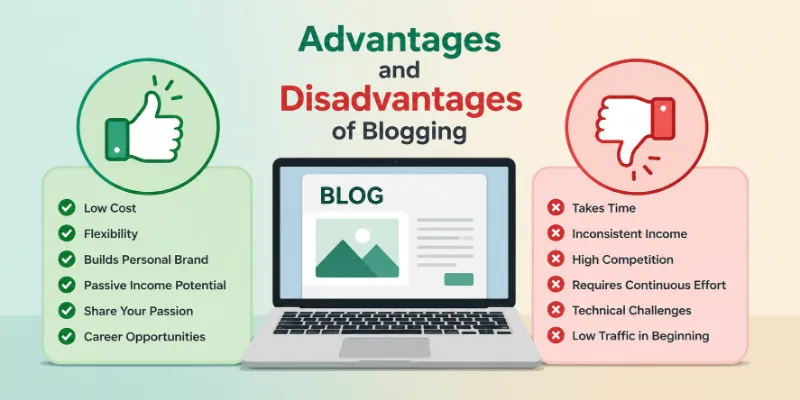
However, these positive outcomes usually require patience and organized work.
Blogging Cons
Starting a blog is easy, but turning it into a trusted visible resource can be difficult. The main blogging disadvantages often become clearer after the first few articles have been published.
- Slow Results
- Consistent Work
- Strong Competition
- Content Maintenance
- Search Changes
- Multiple Skill Requirements
- Website Costs
- Public Feedback
- Legal Responsibilities
- Uncertain Returns
The disadvantages of blogging can help you create a practical plan instead of expecting immediate traffic or income.
1. Slow Results
A new blog may receive very little attention in the beginning. Search engines need time to discover and assess pages, while readers need a reason to trust an unfamiliar website.
Publishing several articles does not guarantee quick growth. A blog may require months of consistent improvement before it starts attracting meaningful traffic.
This slow beginning can discourage people who expect immediate results from their first few posts.
Key Disadvantages:
- Limited early traffic
- No guarantee of quick growth
- Patience is required
2. Consistent Work
A blog needs more than occasional inspiration. Topics must be researched, drafts must be written, facts must be checked, and completed articles must be edited.
Maintaining a realistic schedule can become difficult when blogging is added to a full-time job, business, studies, or family responsibilities.
Long publishing gaps may also make it harder to build momentum and keep returning readers interested.
Key Disadvantages:
- Regular effort is necessary
- Publishing schedules can be difficult
- Motivation may change over time
3. Strong Competition
Many popular topics already have thousands of articles covering similar questions. New blogs must compete with established publishers, well-known brands, video platforms, forums, and AI-generated answers.
Repeating information that already exists may not give readers a strong reason to choose your page. A successful article normally needs clearer explanations, direct experience, original examples, or a more focused angle.
Finding that difference can require careful research and creativity.
Key Disadvantages:
- Many websites target the same topics
- General content may struggle to stand out
- Original value takes extra effort
4. Content Maintenance
Published articles are not always finished forever. Prices, tools, statistics, links, laws, products, and recommended methods can change.
Outdated information may confuse readers and reduce trust. Broken links and old screenshots can also make a website appear neglected.
A growing content library creates more maintenance work because older pages need to be reviewed as well as new ones written.
Key Disadvantages:
- Older posts require regular checks
- Updating many pages takes time
- Incorrect information can harm credibility
5. Search Changes
Search traffic can rise or fall when competition changes or search systems are updated. A page that performs well today may receive fewer visitors later.
Google explains that core updates can affect website traffic and recommends assessing the overall quality of content rather than looking for a single quick fix.
This means bloggers should avoid depending on one article, one keyword, or one traffic source for all their results.
Key Disadvantages:
- Rankings can change
- Traffic may be unpredictable
- Search performance needs monitoring
6. Multiple Skill Requirements
Good writing is important, but blogging often requires several additional skills. A blogger may need to understand keyword research, basic SEO, website management, image selection, analytics, formatting, and promotion.
Learning everything at once can feel overwhelming. Hiring specialists can reduce the workload, but it may increase costs.
Beginners usually need to develop these abilities gradually while continuing to publish.
Key Disadvantages:
- Writing alone may not be enough
- Technical tasks can feel confusing
- Learning several skills takes time
7. Website Costs
A basic blog can be started with a limited budget, but professional growth may involve expenses. These can include a domain name, web hosting, premium themes, plugins, email software, security tools, writers, editors, or designers.
Some expenses are optional, while others become more important as the website grows. Without a clear budget, it is easy to pay for tools that do not provide enough value.
Key Disadvantages:
- Professional tools may cost money
- Expenses can increase with growth
- Poor tool choices can waste budget
8. Public Feedback
Blog content is open to public opinions. Readers may disagree with an argument, point out an error, or leave negative comments.
Useful criticism can improve future content, but rude or unfair responses may affect confidence. Businesses must also handle public replies carefully because emotional reactions can damage their image.
Writers need to separate constructive feedback from comments that offer no useful direction.
Key Disadvantages:
- Work may receive public criticism
- Negative comments can affect motivation
- Responses must be managed professionally
9. Legal Responsibilities
Bloggers are responsible for respecting copyright, using licensed images, protecting reader data, and making honest claims. Sponsored or affiliate content may also require clear disclosure.
The FTC advises people to disclose material relationships with brands so audiences can understand when a recommendation has a commercial connection. Rules vary by country, so bloggers should check the requirements that apply to their own location and audience.
Ignoring these responsibilities can create trust issues and possible legal problems.
Key Disadvantages:
- Disclosure rules must be followed
- Images and text require proper permission
- Legal requirements can vary by location
10. Uncertain Returns
Blogging does not guarantee income, customers, or high visitor numbers. Two websites can publish similar amounts of content and still receive very different results.
Performance depends on factors such as topic demand, content quality, promotion, competition, user experience, and the suitability of the chosen income model.
This uncertainty makes blogging risky for anyone who depends on immediate financial returns.
Key Disadvantages:
- Income is not guaranteed
- Results vary between niches
- Some efforts may produce limited returns
Blogging has valuable uses, but it works best when it is treated as a long-term system rather than a quick method for gaining attention.
How to Maximize the Pros and Minimize the Cons of Blogging
A clear process can make blogging more manageable. You do not need to publish every day or use every available tool. The goal is to create useful content at a pace you can maintain.
- Choose a focused topic: A clear subject makes it easier to understand your audience and plan connected articles.
- Research reader questions: Build topics around real problems instead of writing only about what interests you.
- Create a realistic schedule: Select a publishing frequency that matches your available time and resources.
- Prioritize useful information: Answer the main question clearly before adding extra detail or promotion.
- Add personal experience: Original examples, tests, observations, and lessons can make an article more valuable.
- Use AI carefully: AI tools may support research or organization, but mass-producing pages without adding value can conflict with Google’s spam policies.
- Build an email audience: An email list can help you stay connected with readers instead of depending entirely on search or social platforms.
- Review older posts: Set regular dates to check facts, links, screenshots, and recommendations.
- Measure useful actions: Track sign-ups, enquiries, sales, and reader engagement instead of focusing only on page views.
- Protect quality during growth: Publishing more content should not come at the cost of accuracy, clarity, or originality.
These habits can reduce wasted effort and help each article serve a clear purpose. Progress may still be gradual, but a structured approach makes it easier to identify what is working.
Who Should Start Blogging?
Blogging suits people who enjoy explaining ideas and are willing to improve their work over time. It can be useful for individuals, professionals, organizations, and companies with knowledge that helps a specific audience.
It is especially suitable for people who prefer building a long-term content resource instead of relying only on fast-moving social posts.
Best Fit for Blogging
- Business owners who want to educate potential customers
- Professionals who want to demonstrate their knowledge
- Creators who prefer detailed written communication
- Freelancers who need a strong online portfolio
- Teachers who want to share learning resources
- Companies with products that require explanation
- Hobbyists who want to document useful experience
- Marketers building long-term content campaigns
Blogging may not be the best choice for someone who needs immediate results, dislikes regular writing, or has no time to maintain published information. In such cases, a different format may be more practical.
Conclusion
Is blogging worth starting? The answer depends on your goal and the effort you can give to it. Blogging may bring website traffic, reader trust, leads, and income opportunities. It may also bring slow results, content pressure, website costs, and regular maintenance.
The advantages and disadvantages of blogging make one point clear: publishing posts alone is not enough. You need a topic, an audience, a schedule, and content that helps readers.
Ask yourself one question before starting: can you keep publishing and improving even when results take time? Your answer can help you decide whether blogging is the right choice for you.
FAQs
Still have questions about blogging? Here are clear answers to some of the most common questions beginners ask.
The biggest advantages and disadvantages of blogging depend on your goals and expectations. Blogging helps you share knowledge, build skills, and create income opportunities over time. At the same time, it needs regular effort, patience, and consistent content creation.
Yes, blogging is still worth it if you enjoy writing and want to grow online. Many beginners start a blog to learn new skills, build an audience, or earn money. Success takes time, but steady work can bring good results.
Yes, many people turn blogging into a full-time career after growing their websites. They earn money through ads, affiliate marketing, sponsored posts, and digital products. It usually takes time before blogging provides a stable income.
One of the biggest blogging challenges is creating helpful content on a regular basis. New bloggers also need to learn SEO, attract visitors, and stay motivated. These challenges become easier with practice and experience.
Blogging and social media work best when used together instead of choosing one. A blog gives you full control over your content, while social media helps bring visitors to your website. This combination supports long-term online growth.
Yes, blogging is one of the best ways to improve writing skills through regular practice. Writing blog posts helps you organize ideas and explain topics more clearly. Over time, your confidence and communication also become stronger.
The time to see blogging results depends on your content quality and consistency. Some blogs receive traffic within a few months, while others take longer to grow. Publishing useful articles regularly increases your chances of success.
You can reduce the disadvantages of blogging by creating a content plan and following a regular schedule. Learning basic SEO and focusing on useful topics can also improve your results. Small improvements over time make blogging easier and more rewarding.






- Be Respectful
- Stay Relevant
- Stay Positive
- True Feedback
- Encourage Discussion
- Avoid Spamming
- No Fake News
- Don't Copy-Paste
- No Personal Attacks
- Be Respectful
- Stay Relevant
- Stay Positive
- True Feedback
- Encourage Discussion
- Avoid Spamming
- No Fake News
- Don't Copy-Paste
- No Personal Attacks
