The History of SEO: From Keywords to AI-Driven Strategies
Published: 11 Aug 2026
Every time you type a question into Google and find the right answer within seconds, you are witnessing the result of decades of change behind the scenes. Very few people stop to think about the history of SEO and the events that shaped the rules website owners follow today, yet that background explains almost everything about how modern search works.
This article breaks down that entire journey, starting with the earliest search directories and ending at the AI powered search engines used right now. Along the way, you will meet some of the people who pushed this field forward and see how new technology keeps reshaping the way websites earn visibility.
SEO History: From Early Search Engines to AI
The history of search engine optimization covers several decades of change, shaped by new technology, smarter algorithms, and changing user behaviour. From simple keyword lists to machine learning models, SEO has grown alongside the internet itself.
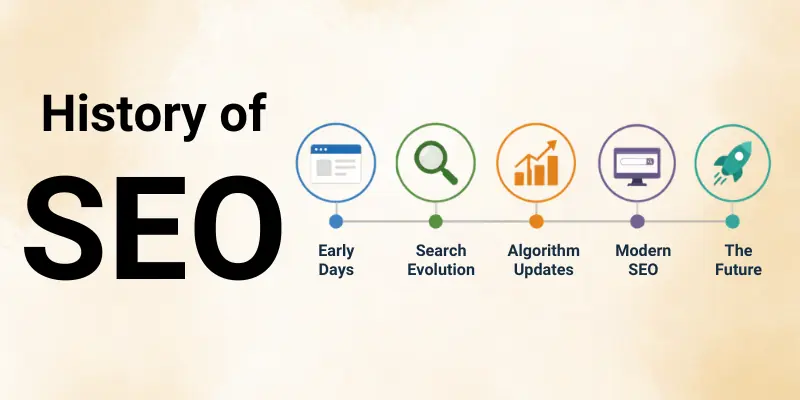
To get a brief history of SEO, it helps to break the search engine optimization history into different eras. Each era introduced new techniques and shaped the way websites rank today.
Eras of SEO History
Early Search Engine Era (1990 to 1997)
The early search engine era marks the starting point of the SEO history timeline. During this period, search engines like Archie, Excite, and Yahoo Directory helped people find information online. Directories organized most websites, and search results depended on simple text matching instead of smart ranking systems.
This era is important because it shows how search started as a basic tool for organizing information, long before ranking factors became complex.
- Early search engines relied on directories and text matching.
- Yahoo Directory organized websites into categories.
- Search results ignored quality signals like backlinks.
- Websites competed mainly on keyword presence.
- The internet was still small compared to today.
Birth of SEO Era (1997 to 1998)
As more websites went online, business owners realized that ranking higher in search results could bring more visitors. This is roughly when did SEO start as a real practice, with webmasters experimenting with meta tags, keyword placement, and page titles to influence rankings.
I find this era interesting because it shows the first real attempts to influence search engines on purpose, rather than by accident.
- Webmasters began adding keywords to meta tags.
- Search engine optimization became a recognized idea.
- Early tactics focused heavily on keyword repetition.
- Website owners started studying search engine behaviour.
- The term “search engine optimization” started appearing online.
Google and PageRank Era (1998 to 2003)
Google launched in 1998 and introduced PageRank, a system that ranked pages based on the quality and number of links pointing to them. This changed the direction of SEO evolution completely, because links became just as important as keywords.
This period changed how marketers think about ranking. I still see backlinks playing a major role in SEO today because Google built its early reputation on measuring trust through links.
- Google introduced PageRank as a ranking factor.
- Backlinks became a major ranking signal.
- Other search engines struggled to compete with Google’s accuracy.
- Marketers started building links intentionally.
- Google quickly became the leading search engine.
Keyword and Link Building Era (2003 to 2010)
During this period, SEO development moved toward aggressive keyword stuffing and mass link building. Website owners created low quality backlinks through directories, forums, and link farms to manipulate rankings. Content quality often took a back seat to ranking tricks.
From what I have studied, this era taught the industry a hard lesson. Rankings built on manipulation rarely last, and Google eventually caught up with these tactics.
- Keyword stuffing became a common practice.
- Link farms and directories grew in popularity.
- Website owners focused on quantity over quality.
- Google began developing smarter detection methods.
- Content quality often suffered during this period.
Algorithm Update Era (2010 to 2015)
Google released major updates like Panda and Penguin during this stage, targeting low quality content and manipulative link building. These updates reshaped the evolution of search engine optimization by rewarding genuine, well written content and penalizing spammy tactics.
I always describe this era as a turning point. It forced marketers to shift from tricking search engines to actually serving readers.
- Panda targeted thin and low quality content.
- Penguin penalized manipulative link building.
- Websites with spammy backlinks lost rankings quickly.
- Content quality became a serious ranking factor.
- SEO strategies became more ethical and sustainable.
Mobile and User Experience Era (2015 to 2019)
As smartphone usage grew, Google shifted its focus toward mobile friendly websites and better user experience. Mobile-first indexing meant that Google started using the mobile version of a website to determine rankings, which changed priorities for businesses everywhere.
This period reminded marketers that rankings depend on more than just words on a page. Speed, design, and usability became just as important as content.
- Google introduced mobile-first indexing.
- Page speed became an important ranking factor.
- User experience signals gained more weight.
- Websites optimized layouts for smaller screens.
- Voice search started influencing keyword research.
AI and Modern SEO Era (2019 to Present)
The current stage of the SEO era combines artificial intelligence with traditional ranking factors. Updates like BERT and advances in machine learning help Google understand search intent rather than just matching keywords. Businesses now focus on answering real questions instead of only targeting exact phrases.
From my observation, technology helps marketers work faster, but understanding the audience still drives real results. The strongest SEO strategies still come from knowing what people actually want to find.
- AI helps Google understand search intent better.
- Content quality and expertise carry more weight.
- Voice and visual search continue to grow.
- Personalization plays a bigger role in results.
- Marketers combine data with creativity for better rankings.
These eras show how SEO changed with technology, but the real story becomes clearer once you know the people behind these changes.
Their decisions shaped how search engines rank websites and set standards that marketers still follow. So, who were the people who changed the history of SEO?
Who Changed the History of SEO?
The history of SEO is not only about different eras. It is also about the individuals who introduced new ideas and changed how websites earn visibility on search engines.
These names shaped the SEO industry in different ways, and each one left behind a lesson that marketers still apply today.
- Larry Page and Sergey Brin: They built PageRank and turned Google into the world’s leading search engine.
- Danny Sullivan: He founded Search Engine Land and helped explain search engine changes to a wider audience.
- Bruce Clay: He is widely credited with popularizing the term “search engine optimization.”
- Matt Cutts: He led Google’s spam fighting team and guided webmasters toward ethical SEO practices.
- Rand Fishkin: He founded Moz and made SEO education accessible to beginners and professionals alike.
- Brian Dean: He introduced content strategies that focused on earning high quality backlinks naturally.
- Neil Patel: He popularized practical, easy to follow SEO advice for small businesses and marketers.
- John Mueller: He continues to guide the SEO community through Google’s official search updates and guidance.
These individuals shaped SEO in their own way, but their combined effect becomes easier to see once you place it on a single timeline. Now let us look at the full evolution timeline of SEO.
SEO Evolution Timeline Table
The search engine optimization timeline below gives a simple summary of how SEO changed from one era to the next.
| Era | Time Period | Simple Explanation |
|---|---|---|
| Early Search Engine Era | 1990 to 1997 | Search engines used directories and basic text matching. |
| Birth of SEO Era | 1997 to 1998 | Webmasters began using keywords and meta tags to rank higher. |
| Google and PageRank Era | 1998 to 2003 | Google introduced backlinks as a major ranking signal. |
| Keyword and Link Building Era | 2003 to 2010 | Marketers focused on keyword stuffing and mass link building. |
| Algorithm Update Era | 2010 to 2015 | Panda and Penguin rewarded quality content and penalized spam. |
| Mobile and User Experience Era | 2015 to 2019 | Mobile-first indexing and page speed became key ranking factors. |
| AI and Modern SEO Era | 2019 to Present | AI helps search engines understand intent, not just keywords. |
This table shows how SEO moved from simple keyword matching to intent based, AI driven strategies. Every era added a new layer to how websites earn visibility today. The next shift is already underway, and it is changing the field once again.
How AI is Changing SEO History
SEO keeps evolving because new AI tools make research and content creation faster than ever before. Many tasks that once took hours, like keyword research and content outlines, now take only a few minutes. This shift is quietly reshaping daily workflows across the industry.
From what I have observed, the real change lies in speed and efficiency, not in replacing human judgment. Marketers still need to understand their audience and craft messages that genuinely help people.
- AI tools speed up keyword research and content planning.
- Search engines increasingly rely on AI to interpret user intent.
- AI powered search experiences are changing how results appear.
- Marketers now spend more time on strategy and less on manual tasks.
- Human insight remains necessary to create content people actually trust.
This stage proves that SEO is still moving forward, and every new tool brings a fresh way of working for marketers. The final section below ties everything together.
Conclusion
We have covered a lot in this journey through the history of SEO. We started with basic search directories, moved through the rise of Google and PageRank, watched keyword stuffing give way to real content quality, and saw how mobile search and artificial intelligence reshaped the entire field. We also met the people who pushed these changes forward and looked at the AI tools that continue to speed up the process today.
What stands out through every era is that SEO always comes back to one goal: connecting people with useful information. Algorithms will keep updating, and new tools will keep arriving, but websites that focus on genuine value tend to survive every shift. Marketers who understand this journey can adapt faster, because they know the reasoning behind the rules rather than just following trends blindly.
Take a moment to go through the FAQs below. They cover some of the most common questions people ask about SEO history and may clear up a few doubts you still have.
FAQs
These frequently asked questions clear up common doubts about the history of SEO before you finish reading.
SEO started around 1997, shortly after search engines began gaining popularity online. Webmasters noticed that ranking higher in search results brought more visitors to their sites.
They began experimenting with keywords, meta tags, and page titles. This marked the beginning of SEO as an intentional practice.
SEO became popular in the early 2000s once Google gained a large user base and businesses realized the value of organic traffic. As more companies moved online, ranking well became a competitive advantage.
Marketers started hiring specialists to handle search visibility. This demand turned SEO into a proper industry.
Google became popular between 1998 and 2000 after introducing PageRank, which ranked pages using backlink quality. This approach gave more accurate results than older search engines.
Users quickly preferred Google over other options. Within a few years, Google became the dominant search engine worldwide.
The first SEO tools focused mainly on keyword tracking and basic site analysis. Simple tools helped webmasters check keyword density and meta tag usage.
Later, tools for backlink tracking and ranking reports appeared. These early tools laid the foundation for the advanced SEO software used today.
SEO has changed from simple keyword stuffing to intent based, user focused strategies. Early tactics relied on tricking search engines with repeated keywords. Over time, algorithm updates rewarded genuine content and better user experience. Today, SEO combines technical accuracy with real audience understanding.
SEO history helps marketers avoid outdated tactics that can harm rankings today. It also explains why certain practices, like quality backlinks and useful content, remain effective.
Knowing the past prevents repeating mistakes from earlier eras. It also builds a stronger foundation for learning modern strategies.
Google updates like Panda and Penguin reshaped SEO by penalizing manipulative tactics. These updates forced marketers to prioritize content quality over keyword tricks.
Websites with spammy links or thin content lost rankings quickly. This pushed the entire industry toward more ethical practices.
AI is shaping SEO by helping search engines understand search intent more accurately. Tools like BERT allow Google to interpret natural language rather than exact keyword matches.
This shift encourages marketers to create helpful, well researched content. As AI continues to advance, understanding user intent will matter more than ever.






- Be Respectful
- Stay Relevant
- Stay Positive
- True Feedback
- Encourage Discussion
- Avoid Spamming
- No Fake News
- Don't Copy-Paste
- No Personal Attacks
- Be Respectful
- Stay Relevant
- Stay Positive
- True Feedback
- Encourage Discussion
- Avoid Spamming
- No Fake News
- Don't Copy-Paste
- No Personal Attacks
