History of Copywriting: From Ancient Era to Modern AI
Published: 9 Jul 2026
Have you ever wondered who started copywriting and why people call it one of the oldest marketing skills in the world? Many beginners learn how to write sales copy, but they never study the history of copywriting. Because of this, they miss the ideas that shaped modern marketing.
I often see people focus only on new tools and trends while ignoring the foundations. In this article, I will explain how copywriting started, how it changed over time, and why its old principles still work today.
Copywriting History: From Ancient to Present
The history of copywriting spans thousands of years and reflects how people changed the way they promoted products, services, and ideas. From handwritten messages in ancient civilizations to digital campaigns and AI tools, copywriting has evolved with every major change in communication.
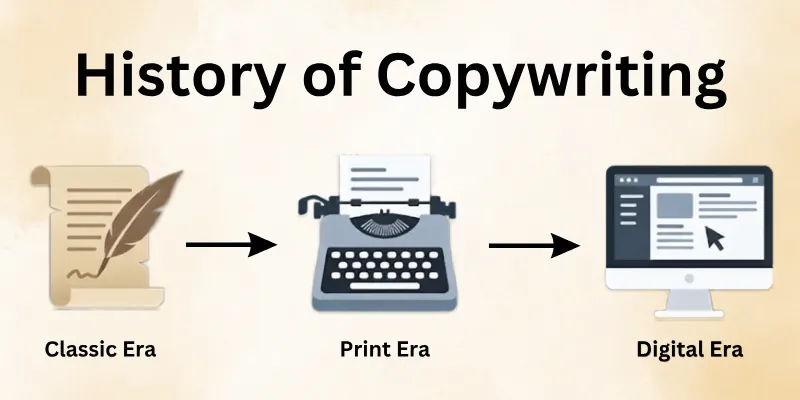
To understand this journey better, it helps to divide copywriting origins into different eras. Each era introduced new methods and shaped the way businesses connect with people today.
Eras of Copywriting History
1. Ancient Advertising Era (3000 BC to 1400 AD)
The Ancient Advertising Era marks the beginning of copywriting history. During this period, merchants used simple words to promote goods and services. They wrote messages on papyrus, stone tablets, and walls to attract buyers. The goal was not to entertain people. They wanted to inform people about what they sold.
This era is important because it proves that persuasion is not a modern skill. Even thousands of years ago, people understood that the right words could grab attention and increase sales.
- Merchants used handwritten advertisements.
- Ancient Egypt produced some of the earliest known ads.
- Most messages focused on products and services.
- Advertising relied on simple and direct language.
- Persuasion became an important part of trade.
2. Printing Press Era (15th to 17th Century)
The invention of the printing press changed the way people shared information. Businesses could print many copies of advertisements instead of writing them by hand. This helped sellers reach more people in less time.
When I study this period, I see it as a turning point in copywriting history. It opened the door for mass communication and gave advertisements a much wider audience.
- The printing press increased the reach of advertisements.
- Printed ads became easier to distribute.
- Businesses started promoting products more regularly.
- Readers gained access to more commercial information.
- Advertising began to grow as a business activity.
3. Newspaper and Magazine Era (17th to 19th Century)
As newspapers and magazines became popular, advertising entered people’s daily lives. Businesses placed ads in publications to attract local and national customers. Writers started paying more attention to headlines and message structure.
This era teaches an important lesson. Good writing became just as important as the product itself because readers had many advertisements competing for their attention.
- Newspapers became major advertising platforms.
- Headlines started gaining more importance.
- Advertisers targeted larger audiences.
- Magazines introduced more creative advertisements.
- Competition encouraged better writing styles.
4. Professional Copywriting Era (Late 19th Century)
The late nineteenth century introduced professional copywriters. Businesses hired skilled writers to create persuasive advertisements instead of writing ads themselves. Copywriting became a recognized profession.
I believe this era gave copywriting its professional identity. Writers no longer focus only on describing products. They focused on convincing people to take action.
- Companies hired professional copywriters.
- Advertising agencies started growing.
- Persuasive writing became a valuable skill.
- Writers specialized in sales messages.
- Copywriting developed as a career.
5. Scientific Advertising Era (1900 to 1920)
The Scientific Advertising Era introduced research into copywriting. Writers studied customer behaviour and tested different advertisements to learn what worked best. They relied on facts instead of guesses.
This period changed the way advertisers think. I still see many of its principles used today because understanding customers remains an important part of good copywriting.
- Copywriters used customer research.
- Testing became a common practice.
- Headlines received more attention.
- Advertisements focused on benefits.
- Writers used facts to support claims.
6. Golden Age of Advertising (1920s to 1960s)
The Golden Age of Advertising brought creativity to the center of copywriting. Businesses no longer relied only on facts and product details. They started using emotions, stories, and memorable slogans to connect with people. Radio, magazines, and later television helped advertisements reach millions of homes.
I always consider this era one of the most influential periods in copywriting history. Many techniques that copywriters use today, such as emotional appeal and storytelling, became popular during these decades.
- Advertisers used emotions to influence buying decisions.
- Storytelling became an important writing technique.
- Radio and television expanded the reach of advertisements.
- Memorable slogans gained popularity.
- Brands started building long-term customer relationships.
7. Direct Response Era (1960s to 1990s)
The direct response era focused on getting an immediate action from readers. Copywriters wrote long sales letters, brochures, and mail campaigns that encouraged people to buy, call, or send an order form. Every sentence had a clear purpose and pushed readers toward a specific action.
From my experience studying copywriting, this era teaches one of the biggest lessons. Good copy should not only sound attractive. It should motivate people to act.
- Advertisements focused on immediate responses.
- Long-form sales letters became common.
- Clear calls to action appeared more often.
- Results became easier to measure.
- Copywriters paid close attention to customer needs.
8. Digital Copywriting Era (1990s to 2010)
The rise of the internet changed copywriting once again. Businesses started creating websites, email campaigns, and online advertisements. Writers learned how to write for screens instead of newspapers and magazines. They also focused on making content easy to read and search online.
I remember how this period transformed the industry. Copywriters had to adapt quickly because online readers behaved differently from traditional readers.
- Websites became important marketing tools.
- Email marketing gained popularity.
- Online advertisements reached global audiences.
- Writers adapted to shorter reading habits.
- Search engine visibility became important.
9. Social Media and Content Marketing Era (2010 to Present)
Social media changed how brands communicate with people. Businesses now create content that informs, entertains, and builds trust. Copywriters write captions, blogs, video scripts, and social media posts that encourage interaction instead of only promoting products.
I have noticed that modern audiences prefer helpful and honest content. They want brands to speak naturally and provide value before asking for a sale.
- Social media became a major marketing channel.
- Content marketing grew rapidly.
- Brands focused on engagement and trust.
- Short and clear messages became more effective.
- Businesses created content for different platforms.
10. AI and Modern Copywriting Era (2020 to Present)
The current era combines technology with human creativity. Writers use different tools to speed up research and drafting, but people still rely on human ideas, emotions, and experience to create persuasive messages. Businesses now value originality, authenticity, and audience understanding more than ever.
From what I have seen, technology can assist copywriters, but it cannot replace human judgment and creativity. The strongest copy still comes from people who understand other people.
- Technology helps writers work faster.
- Human creativity remains essential.
- Businesses prefer authentic communication.
- Personalization has become more important.
- Copywriters now combine traditional skills with modern tools.
These eras show how copywriting changed with time, but the real story becomes even more interesting when you look at the people behind these changes.
Their ideas shaped advertising, influenced millions of buyers, and created principles that copywriters still follow today. So, who were these legendary writers who changed the history of copywriting forever?
Who Changed the History of Copywriters?
The history of copywriting is not only about different eras. It is also about the people who introduced new ideas and changed how businesses communicate with customers.
These names changed advertising works and shaped modern copywriting. Each one brought a different style that still guides writers today. Let’s look at the people who shaped this field.
- John Emory Powers: He wrote simple ads that focused on honesty and clear selling.
- Claude Hopkins: He used testing and research to improve ad results.
- Robert Collier: He wrote in a friendly, personal tone that felt direct.
- David Ogilvy: He mixed creativity with deep customer understanding.
- Eugene Schwartz: He focused on human desire instead of fancy wording.
- Gary Halbert: He used strong, simple sales letters that pushed action.
- Joseph Sugarman: He wrote engaging copy that kept readers hooked.
- Leo Burnett: He built strong brand ideas that people easily remember.
- Rosser Reeves: He promoted one clear message for a stronger impact.
- John Caples: He tested headlines to find what truly grabs attention.
These legends changed copywriting in their own way, but the real story becomes clearer when you see how all their ideas connect into one journey. Now let’s look at the full timeline of copywriting history.
Copywriting Evolution Timeline Table
The history of copywriting timeline shows how this skill changed step by step over time. The table below gives a clear view of these changes in a simple order.
| Era | Time Period | Simple Explanation |
|---|---|---|
| Ancient Advertising Era | 3000 BC – 1400 AD | People used simple written messages on walls, stone, and papyrus to attract buyers. |
| Printing Press Era | 15th – 17th Century | Printing made it easy to spread advertisements to large audiences. |
| Newspaper & Magazine Era | 17th – 19th Century | Businesses used newspapers and magazines to reach more customers. |
| Professional Copywriting Era | Late 19th Century | Companies started hiring writers to create strong advertising messages. |
| Scientific Advertising Era | 1900 – 1920 | Copywriters used testing and customer research to improve results. |
| Golden Age of Advertising | 1920s – 1960s | Ads focused on emotions, storytelling, and brand identity. |
| Direct Response Era | 1960s – 1990s | Copy focused on getting immediate action, like calls or purchases. |
| Digital Copywriting Era | 1990s – 2010 | Websites, emails, and online ads changed how writing worked. |
| Social Media Era | 2010 – Present | Brands started using social platforms to connect and engage users. |
| AI Copywriting Era | 2020 – Present | Tools help with writing, but human thinking still guides strategy. |
This timeline shows how copywriting moved from simple messages to modern digital writing. Each era added a new layer to how people communicate and sell ideas. Now the next change is already happening, and it is shaping the future in a new way. Let’s understand this change.
How AI is Changing Copywriting History
Copywriting is changing because new writing tools make work faster and simpler. Many basic tasks now take less time, so writers can focus more on ideas and planning. This shift is slowly changing how the industry works.
From my view, the real change is in the workflow, not the writer. People still need to understand emotions, behaviour, and clear messaging. Tools only help with speed, not with real thinking.
- Writing tasks now take less time due to new tools.
- Idea creation has become quicker and easier.
- Writers spend more time on planning and strategy.
- Human understanding still guides strong copy.
- Tools support work but do not replace creative thinking.
This stage shows that copywriting is still changing with time, and every new shift brings a new way of working for writers. The next section will bring all the key ideas together in a simple ending.
Conclusion
In this guide, we have covered the history of copywriting. We explored how copywriting started from simple ancient messages and slowly changed into modern digital writing. Along the way, we also saw that every era brought both progress and new challenges.
Copywriting tools and methods keep changing, but the core skill is still understanding people. If we focus too much on tools, we may miss the real message. If we focus only on old methods, we may fall behind. The best way is to mix learning from history with modern practice.
Don’t miss the FAQs ahead. They may add more value to your learning, so read them. Skipping them could mean losing useful insights.
FAQs
The FAQs below will clear the main doubts about the history of copywriting before you finish reading.
The history of copywriting shows how persuasive writing started and evolved. It begins with ancient messages used to sell goods and ends with modern digital marketing. Today, it includes websites, ads, and social media content.
Copywriting started thousands of years ago in early civilizations like Egypt and Babylon. People used simple written messages to promote goods and services. This is considered the early stage of marketing communication.
The history of copywriting helps beginners understand how writing for sales has changed. It shows what techniques still work today and why they work. Learning it builds a strong foundation for modern copywriting skills.
Copywriting evolved from simple written ads to printed newspapers, then to digital platforms. Each stage introduced new tools and new writing styles. Today, it focuses on online content and user engagement.
Many experts shaped the history of copywriting, including David Ogilvy and Claude Hopkins. They introduced research-based and emotional writing styles. Their ideas still guide modern advertising.
The main stages include ancient advertising, print media, direct mail, and digital marketing. Each stage improved how businesses connect with customers. The latest stage includes AI-assisted writing tools.
It helps marketers understand customer behaviour and proven writing methods. Old principles like strong headlines and clear messaging still work today. This makes campaigns more effective.
The future of copywriting will mix human creativity with modern tools. Writers will focus more on ideas and strategy than basic writing. The history of copywriting shows that change will always continue.






- Be Respectful
- Stay Relevant
- Stay Positive
- True Feedback
- Encourage Discussion
- Avoid Spamming
- No Fake News
- Don't Copy-Paste
- No Personal Attacks
- Be Respectful
- Stay Relevant
- Stay Positive
- True Feedback
- Encourage Discussion
- Avoid Spamming
- No Fake News
- Don't Copy-Paste
- No Personal Attacks
