How to Earn from Digital Marketing: Best Ways to Earn Money
Published: 17 Sep 2026
If you type how to earn from digital marketing into a search bar, you will land on dozens of pages, each one telling you something a little different. One page says you need certifications, another says you just need a laptop and Wi-Fi, and somewhere in between, most beginners give up before they even start.
Here is the truth: this field rewards action more than credentials. You can pick up the fundamentals, test them on small projects, and grow from there, regardless of your background. This guide breaks the whole process down into plain, usable steps so you are not left guessing what to do next.
What You Need Before You Get Started
You do not need a fancy setup to begin. A handful of basics will carry you through the early stages while you figure out where your strengths lie.
A Working Device: Whether it is a laptop or just your phone, you need something to create content, research trends, and stay in touch with clients or your audience.
Reliable Internet Access: This is where the work actually happens: research, learning, client calls, and managing accounts all depend on it.
Some Comfort with Social Platforms: You do not need to be an influencer, but knowing how Instagram, Facebook, or LinkedIn function day-to-day will help immensely.
An Openness to Trying New Tools: Platforms and algorithms shift constantly in this field, so staying curious about new apps and features keeps you ahead.
Enough Writing Ability to Explain Yourself: You are not writing novels here. You just need to get an idea across clearly, whether it is a caption, an email, or a pitch to a client.
Blocks of Time to Actually Practice Skills like ad management or content strategy only sharpen through repetition, so carve out time each week to work on them.
A Handful of Sample Projects: You do not need paying clients to build proof of skill. Mock campaigns or practice pages work just fine to show what you can do.
A Realistic Mindset About Pace: This is not an overnight business. People who stick with it past the slow first weeks usually end up earning consistently.
With those basics covered, the next question is where to actually begin. Below is a step-by-step path you can follow from complete beginner to earning your first income.
How to Earn Money from Digital Marketing
There is no need to feel behind if you are starting with zero experience. Figuring out how to earn money from digital marketing is really just a matter of working through the right steps in order.
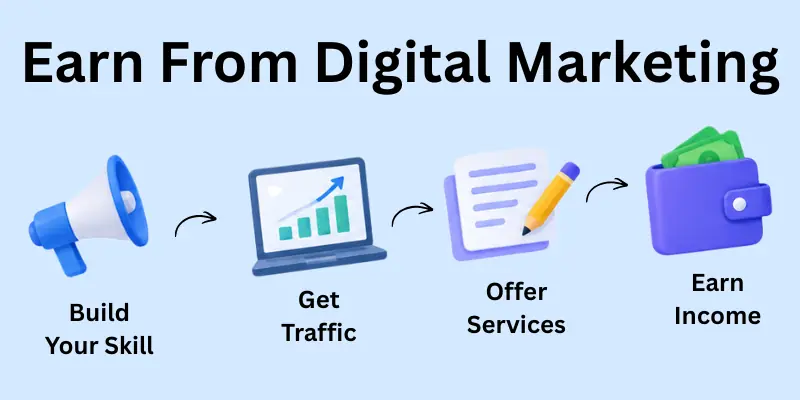
Step 1: Get Comfortable with the Fundamentals
Before anything else, understand what this field actually involves: reaching people online through channels like social media, search engines, email, and paid ads.
You are not expected to know everything right away. The goal at this stage is just to understand that your job is connecting brands with the right people.
Spend your early time learning:
- How online platforms decide what content people see
- Why certain posts or ads get more attention than others
- Simple concepts like knowing your audience and guiding them toward a decision
Step 2: Narrow Your Focus to One Area
Narrowing your focus makes learning faster and gives potential clients a clear reason to trust you with a specific task. Trying to learn every skill at once usually backfires. Instead, pick a lane, such as;
- Managing social media accounts
- Search engine optimization
- Email campaigns
- Running paid ads on Google or Meta
Step 3: Build Real Experience Through Practice Work
Do not sit around waiting for a client to appear. Create your own opportunities to practice. Approach these projects with the same care you would give paid work. This is what actually builds your speed and confidence.
- Set up a small test ad with a tiny budget
- Manage a mock brand page
- Draft a sample email sequence
- Put together a basic SEO audit for a local shop
Step 4: Put Together a Portfolio
Your portfolio does the talking for you. Well-organized, thoughtful samples matter more than having dozens of pieces. Gather your strongest practice pieces into one place so people can see them easily. You can:
- Build a simple free website to display your work
- Organize everything neatly in a shared folder or document
Step 5: Get Visible on the Right Platforms
Fill in your skills honestly, write a short and direct bio, and attach your portfolio. Make it obvious what problem you solve for businesses. Head to where clients are actually browsing for help. Set up profiles on sites such as
- Upwork
- Fiverr
Step 6: Put Yourself Out There Consistently
Keep your outreach short and focused: who you are, what you can do, and how it benefits them specifically. This is where momentum builds. Make it a habit to:
- Submit proposals on relevant job listings
- Send personalized messages to small business owners
- Offer a quick free trial or audit to demonstrate your value upfront
Step 7: Deliver Quality Work and Ask for Proof of It
Afterward, ask directly for a testimonial or review. Social proof from even one happy client opens doors to the next one. Once a client says yes, your job is to make that first project count. That means:
- Getting clarity on their goals before starting anything
- Checking in with questions rather than guessing
- Showing them the actual results, not just the finished work
Step 8: Sharpen Your Skills and Price Accordingly
Stronger skills naturally justify stronger pricing. Staying at beginner rates forever limits your growth. As you gain more experience:
- Pick up advanced strategies and tools in your chosen area
- Study campaigns that are already working well in your niche
- Consider certifications through Google Ads or Meta Blueprint
Step 9: Shift Toward Ongoing Client Relationships
Clients who stick around save you the constant hustle of chasing new leads every month. One-off projects are fine to start, but recurring work is where stability comes from. Offer options like
- Monthly social media management
- Continuous ad campaign oversight
- Regular email marketing support
Step 10: Expand Beyond Your Starting Point
At this point, what started as a side skill can turn into a full income stream if you keep showing up and improving. Once you have a track record, look for ways to grow your income further. This might mean:
- Focusing on a lucrative niche like e-commerce
- Partnering with an agency
- Bundling your services into premium packages
That covers the path from learning to earning, but freelancing is not the only route available. The next section breaks down the different ways this skill can actually pay you.
Best Ways to Make Money with Digital Marketing
Freelancing is one route, but it is far from the only one. Ways to make money with digital marketing span several formats, so you can pick whichever fits your strengths and interests best.
Freelance Services: Take on individual projects for clients, from managing accounts to running campaigns, and get paid per task.
Content Creation: Grow a following on platforms like YouTube or Instagram, then monetize through sponsorships and brand partnerships.
Affiliate Promotion: Share product links with your audience and earn a cut every time someone buys through them.
SEO Services: Help websites climb search rankings and charge businesses for ongoing optimization work.
Ad Campaign Management: Handle paid advertising for clients on platforms like Google or Meta in exchange for a monthly fee.
Email Marketing Support: Design and manage campaigns that keep businesses in regular contact with their customers.
Strategic Consulting: Once you have enough experience, charge for advice and planning rather than hands-on execution.
Digital Products: Package what you know into a course, template, or guide, and sell it directly to others learning the same skills.
Each of these paths brings in income differently, so it comes down to what matches your lifestyle. Once you have an idea of the method that suits you, the next step is knowing exactly where to find the people willing to pay for it.
Best Platforms to Earn Money from Digital Marketing
Understanding the methods only helps once you know where to actually apply them. If your goal is to earn money from digital marketing, these are places where real demand already exists.
- Upwork: Clients post projects here regularly, and you submit proposals to compete for the work.
- Fiverr: Instead of applying to jobs, you list packaged services and wait for interested clients to reach out.
- LinkedIn: A strong place to build professional relationships and land direct opportunities through networking.
- Meta Business Suite: Once you land social media clients, this is where you will manage their pages and ad accounts.
- Google Ads: Learning this platform hands-on is valuable, since many businesses pay well for someone who can run it properly.
- YouTube: Beyond client work, this lets you build your own audience and earn through ads, sponsorships, and promotions.
- Amazon Associates or ClickBank: These affiliate networks give you products to promote and a commission structure to earn from.
- Direct Outreach: Skipping platforms entirely and contacting small businesses yourself often works just as well, if not better.
Knowing these platforms gives you a starting point for actually landing work rather than just learning in theory. Getting your foot in the door is only half the story, though. What happens after that determines how much you actually earn.
Tips to Earn More Money with Digital Marketing
Landing your first few projects is a milestone, but growing your income from there requires a shift in approach. A lot of beginners plateau simply because they keep doing things the same way.
- Tie Your Work to Outcomes: Clients remember results like increased sales or leads far more than the amount of effort you put in.
- Commit to One Specialty: Being known for one thing builds authority, and authority is what allows you to charge more.
- Stay Current with New Tools: This industry shifts quickly, so regularly updating your skill set keeps you relevant and in demand.
- Study What Drives Decisions: Understanding why people engage, buy, or scroll away helps you create content that actually performs.
- Prioritize Repeat Business: Clients who return save you the time and energy of constantly searching for new leads.
- Refresh Your Portfolio Often: Replace older samples with recent, stronger work so people can see your progress clearly.
- Keep Your Communication Direct: Clear, honest updates build the kind of trust that keeps clients working with you longer term.
- Raise Prices in Small Steps: Adjust your rates gradually as your results and confidence build, rather than all at once.
Small shifts like these are usually what separate someone stuck doing small gigs from someone building a real income.
Final Takeaway
By now, you have a complete, practical picture of how to earn from digital marketing, from the basic tools you need to the exact steps that lead to your first paying project and beyond.
There is no need to rush any part of this. Start small, apply what you are learning in real situations, and let each project teach you something new. That steady approach is what actually compounds over time.
From here, the next move is yours: keep learning, keep building proof of your skills, and keep reaching out even when it feels uncomfortable. Momentum in this field tends to build quietly before it becomes obvious.
FAQs
Here are answers to some of the questions beginners ask most often, so you can move forward with a clearer head.
1. How long does it usually take to land the first paying project?
This varies a lot from person to person. Some people find small work within a few weeks, while others take a couple of months to get their first yes.
Having a solid portfolio and reaching out consistently speeds things up considerably. Patience combined with steady effort tends to matter more than raw talent here.
2. Is a degree necessary to get into this field?
Not at all. Most clients care far more about the results you can show than where you studied. You can pick up everything you need through free tutorials, hands-on practice, and structured online courses. A strong portfolio often carries more weight than any certificate ever will.
3. Which skill within this field tends to pay the best?
Paid advertising and search engine optimization often command higher rates because they directly influence a business’s revenue. That said, your actual income also depends heavily on your experience and the industry you work within. Choosing a niche with strong demand usually leads to better pay over time.
4. Can this realistically work as a side hustle alongside a full-time job?
Yes, many people start this way while keeping their regular job for stability. Freelance projects and content creation both allow flexible schedules, so you can fit the work around existing commitments. Once your client base grows, you can decide whether to transition into it full time.
5. What is the fastest way to land a first client?
Reaching out directly to small, local businesses tends to work faster than waiting on platforms alone. Offering a small free sample or a quick audit can also demonstrate your value before anyone commits to paying.
Freelance sites like Upwork and Fiverr are useful too, since businesses there are already looking to hire.
6. Do I need to spend money to get started?
Not necessarily. Skills like content writing or account management can be learned and practiced without spending anything. Some areas, like running paid ads, may need a small test budget, but you can start with very little and scale up as your income grows.
7. What kind of income can a beginner realistically expect?
Early income tends to be modest while you are still building your portfolio and reputation. As your skills sharpen and your client list grows, your earning potential rises significantly. Staying consistent and continuously improving are the biggest factors that separate low earners from high earners.
8. Is this a stable career path in the long run?
Yes, since businesses will always need help reaching customers online in some form. With enough experience, many people move into consulting, agency roles, or start their own marketing businesses. Demand for these skills continues to grow across nearly every industry.



- Be Respectful
- Stay Relevant
- Stay Positive
- True Feedback
- Encourage Discussion
- Avoid Spamming
- No Fake News
- Don't Copy-Paste
- No Personal Attacks
- Be Respectful
- Stay Relevant
- Stay Positive
- True Feedback
- Encourage Discussion
- Avoid Spamming
- No Fake News
- Don't Copy-Paste
- No Personal Attacks
